Moving to Portugal from Asia: What You Actually Need
Moving to Portugal from an Asian country means moving as a third-country national. That single fact shapes everything: you cannot simply arrive and settle, you need a national visa issued before you travel, and almost every document you own will need an apostille and a certified Portuguese translation.
None of it is unusually hard. It is, however, slow and sequential, and the people who struggle are almost always the ones who started the paperwork too late.
Before you rely on any of this: Portuguese immigration rules change often, and they changed substantially in 2024 and again in 2026. Requirements also differ by consulate and by nationality. Treat this as orientation, then confirm your own case with the Portuguese consulate that covers you, with AIMA, or with a qualified immigration lawyer. Nothing here is legal advice.
The sequence that actually works
| Stage | Where | What happens |
|---|---|---|
| 1. Choose your route | Home country | Work, study, passive income, remote work or family reunification. This determines every document that follows. |
| 2. Get a NIF | Remotely or in Portugal | Portuguese tax number. Needed for a lease, a bank account, almost everything. Non-residents usually need a fiscal representative. |
| 3. Gather and apostille documents | Home country | The slowest stage. Birth and marriage certificates, criminal record, qualifications. See our apostille guide. |
| 4. Apply for the visa | Consulate / VFS | Biometrics, documents, fee. See applying from Asia. |
| 5. Travel to Portugal | — | Your visa is valid for a limited entry window and normally comes with an AIMA appointment or instructions to obtain one. |
| 6. AIMA appointment | Portugal | Biometrics and documents again. This produces your residence permit card. |
| 7. Register locally | Portugal | NISS (social security), health centre, bank, utilities. |
Realistically, budget 6 to 12 months from decision to landing. Document collection and consulate appointment availability are the two things you cannot rush.
The documents nearly everyone needs
- Passport valid well beyond your intended stay, with blank pages.
- Criminal record certificate from your home country, and from anywhere you have recently lived — apostilled and translated. These have short validity windows, so time them carefully.
- Proof of accommodation in Portugal — a lease, a property deed, or in some cases a formal invitation.
- Proof of means of subsistence — bank statements, contract, pension or income evidence, depending on route.
- Health insurance valid in Portugal covering the initial period.
- Birth certificate, and marriage certificate if bringing a spouse — apostilled and translated.
- Passport photographs to the consulate's specification.
- Consent to a Portuguese criminal record check.
Every foreign-language document will need a certified Portuguese translation. Arrange apostilles in your home country before departure — doing it retroactively from Portugal is slow, expensive and occasionally impossible.
Which route fits you
| Visa | For |
|---|---|
| D1 | You have a Portuguese employment contract |
| D2 | Entrepreneurs, freelancers and independent professionals |
| D3 | Highly qualified activity, including the EU Blue Card route |
| D4 | Students on a course longer than a year |
| D6 | Family reunification with someone already resident |
| D7 | Passive income — pensions, rentals, dividends |
| D8 | Remote workers and digital nomads with foreign income |
Income thresholds are tied to the Portuguese minimum wage and revised annually, so check the current figure rather than an older blog post. More in our visa guide and working in Portugal as a non-EU citizen.
One route that no longer exists
Until 2024 it was possible to enter Portugal as a visitor and then regularise your status from inside the country through the manifestação de interesse, an expression-of-interest process. Large numbers of South Asian workers used it.
That route was closed in 2024. Arriving on a tourist visa intending to regularise later is no longer a viable plan, and anyone telling you otherwise is working from outdated information. Get the correct visa before you travel.
After you arrive
- AIMA appointment. Where your residence permit is actually issued. Appointments have been a significant bottleneck, so attend with every document, originals included.
- NISS — your social security number, needed to work legally.
- Health centre. Register at your local centro de saúde to access the SNS.
- Bank account. Needs your NIF, proof of address and ID.
- Driving licence. Exchange rules depend on your country; some have agreements with Portugal, others require a Portuguese test.
The requirement people discover too late
Permanent residency and citizenship both require A2 Portuguese, normally proven through the CIPLE exam. It is not tested at the visa stage, which is exactly why people forget it — then find themselves with years of residency accrued and no language ability at all.
A2 is genuinely achievable: 4 to 6 months at 20 to 30 minutes a day. Start during the visa wait, when you are doing nothing but waiting anyway. It must be European Portuguese, not the Brazilian variant most apps teach, and the CIPLE guide covers the exam.
Country-specific guidance: Indians moving to Portugal and moving from China.
Frequently asked questions
Can I move to Portugal from Asia without a job offer?
Yes, through several routes. The D7 suits people with passive income such as pensions, rentals or dividends. The D8 suits remote workers earning from foreign clients or employers. The D2 suits entrepreneurs and freelancers. A job offer is only required for the D1 work visa.
How long does it take to move to Portugal from Asia?
Budget 6 to 12 months from decision to arrival. Gathering and apostilling documents typically takes 1 to 3 months, consulate appointment availability can add weeks or months, and visa processing varies by consulate and season.
Can I go to Portugal on a tourist visa and then apply to stay?
No. The expression of interest route, known as manifestacao de interesse, which previously allowed regularisation from inside Portugal, was closed in 2024. Non-EU nationals now need to obtain the correct national visa before travelling.
Do I need to speak Portuguese to get a Portugal visa?
No, there is no language requirement at the visa stage. However A2 level Portuguese is required later for permanent residency and citizenship, normally proven through the CIPLE exam, so it is worth starting during the visa wait rather than years later.
What is a NIF and do I need one before arriving in Portugal?
A NIF is the Portuguese tax identification number, needed for renting, banking, utilities and most official processes. Many people obtain one before arrival through a fiscal representative, since non-residents generally require one.
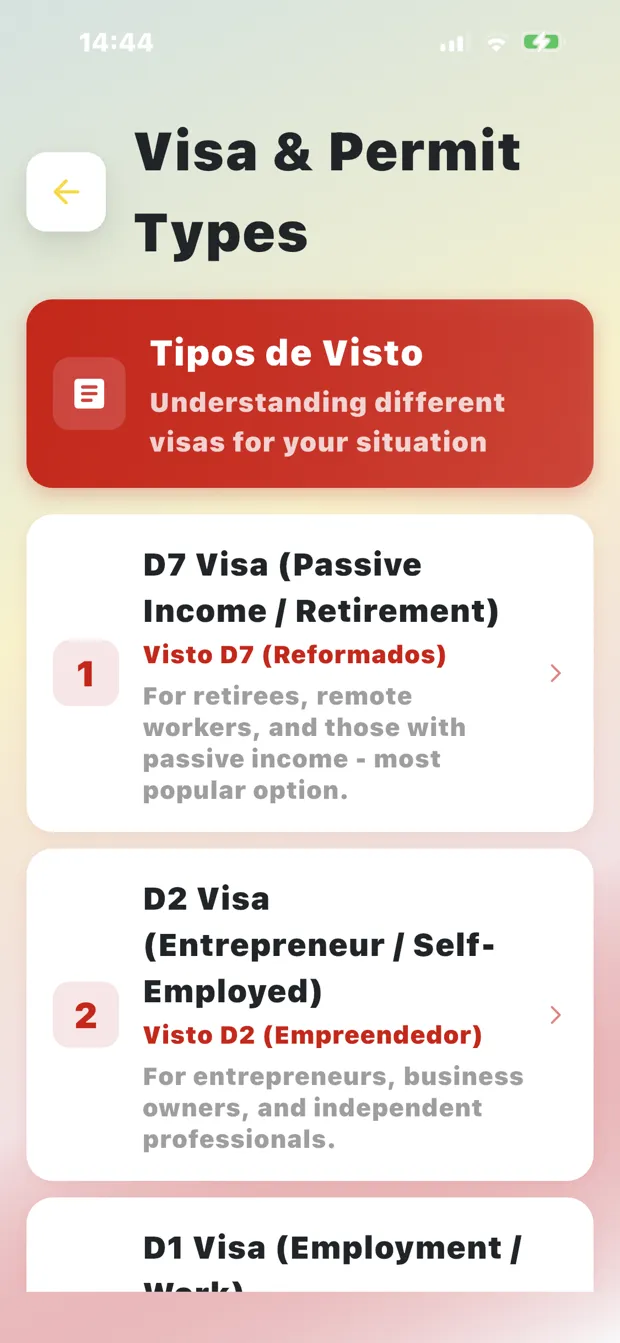
The language requirement starts counting now
A2 Portuguese is required for permanent residency and citizenship, and the visa wait is dead time you can use. Portugal Lifestyle Pro teaches European Portuguese with native Lisbon and Porto audio, follows the CEFR framework from A1 upward, and includes the AIMA and immigration vocabulary you will actually need at the counter.
Download Free on the App Store Google Play Web App
Free download · 7-day free trial · 500+ lessons · Native Lisbon audio
On the App Store as Learn European Portuguese Pro
What should we build next?
This guide exists because someone asked for it. If there's a topic, lesson type or feature you want in Portugal Lifestyle Pro, tell us — it's five questions and takes about two minutes.
Share your ideas & feedback → No account needed · Email optional · We read every answer