Apostille and Certified Translation for Portugal
This stage delays more Portugal applications than any other, and it is almost entirely avoidable. Documents issued in one country are not automatically valid in another. To make yours usable in Portugal they generally need legalisation — usually an apostille — and a certified Portuguese translation.
Before you rely on any of this: Portuguese immigration rules change often, and they changed substantially in 2024 and again in 2026. Requirements also differ by consulate and by nationality. Treat this as orientation, then confirm your own case with the Portuguese consulate that covers you, with AIMA, or with a qualified immigration lawyer. Nothing here is legal advice.
What an apostille actually is
An apostille is a standardised certificate attached to a public document confirming that the signature and seal on it are genuine. It exists under the Hague Apostille Convention and replaces the older, slower chain of consular legalisation between member countries.
It does not verify that the contents are true. It only confirms the document was authentically issued. Portugal is a member, so an apostille from another member country is accepted without further consular steps.
Does your country issue apostilles?
| Country | Apostille | Typically issued by |
|---|---|---|
| India | Yes | Ministry of External Affairs, after state-level authentication |
| China (mainland) | Yes — since November 2023 | Ministry of Foreign Affairs or authorised provincial offices |
| Hong Kong & Macau | Yes, long-standing | Designated local authority |
| Japan | Yes | Ministry of Foreign Affairs |
| South Korea | Yes | Ministry of Foreign Affairs |
| Singapore | Yes | Designated authority |
| Philippines | Yes | Department of Foreign Affairs |
| Indonesia | Yes | Ministry of Law and Human Rights |
| Pakistan | Yes — acceded relatively recently | Ministry of Foreign Affairs |
| Vietnam, Nepal, Bangladesh, Thailand | No | Consular legalisation route instead |
China's accession in November 2023 is a genuinely useful change. Documents from mainland China that previously required full consular legalisation can now take the much faster apostille route — and a lot of guidance still online predates it.
Membership changes over time, so verify your country's current status before planning around it.
If your country is not a member
You use consular legalisation instead, which is a chain rather than a single stamp. Typically: notarisation, then authentication by your foreign ministry, then legalisation by the Portuguese embassy or consulate in that country.
It is slower and involves more fees, so start considerably earlier. Some documents may also need to be issued in a particular form before any of it can begin.
Which documents need it
- Birth certificate — for you and any children
- Marriage certificate — for spouse visas and family reunification
- Criminal record certificate — from home and anywhere you have recently lived
- Educational certificates and degrees — for study, work and highly qualified routes
- Professional qualifications — where recognition is needed
- Divorce, adoption or death certificates — where relevant to your case
Bank statements, employment contracts and tenancy agreements usually do not need an apostille, though they will often still need translation.
The order matters
Get this wrong and you pay twice. The correct sequence:
- Obtain the document in its official, current form. Old certificates are sometimes rejected outright.
- Apostille it in the issuing country.
- Translate it into Portuguese, including the apostille itself.
- Certify the translation so it is legally recognised.
Translating before apostilling means the apostille is not covered by the translation, and you may be sent back to redo it.
Certified translation
A certified translation is not simply an accurate one. It must carry formal certification that Portuguese authorities accept — in practice usually a translator whose work is certified through a notary, lawyer, chamber of commerce or Portuguese consulate, depending on where it is done.
Two practical points. Translation done in Portugal is often easier to get accepted than translation done abroad, though it means shipping originals. And be consistent with your name: use one spelling across every translated document, because inconsistent transliterations cause real problems at AIMA later.
Timing and validity
Criminal record certificates in particular have short validity windows, often only a few months. Sequence them so they are still valid at submission and ideally at your AIMA appointment months afterwards.
A workable order: gather birth, marriage and education documents first, apostille and translate those, then request criminal record certificates last so their clock starts as late as possible.
Keep several certified copies. You will be asked for the same documents at the consulate, at AIMA, at the bank, at the town hall and at your children's school enrolment.
Frequently asked questions
What is an apostille and why does Portugal need one?
An apostille is a standardised certificate confirming that the signature and seal on a public document are genuine. It exists under the Hague Apostille Convention, of which Portugal is a member, and replaces the slower chain of consular legalisation between member countries.
Does China issue apostilles for documents used in Portugal?
Yes. Mainland China acceded to the Hague Apostille Convention with effect from November 2023, so Chinese public documents can now use the apostille route rather than full consular legalisation. Hong Kong and Macau have been covered for much longer.
What if my country is not part of the Hague Apostille Convention?
You use consular legalisation instead, a chain rather than a single stamp: notarisation, then authentication by your foreign ministry, then legalisation by the Portuguese embassy or consulate. It takes longer and costs more, so start earlier.
Should I translate documents before or after the apostille?
Apostille first, then translate, and the translation should include the apostille itself. Translating first often means the apostille is not covered by the certified translation and the work has to be redone.
How long is a criminal record certificate valid for a Portugal visa?
Validity windows are short, often only a few months. Request criminal record certificates late in your document-gathering process so they remain valid at submission and ideally at your AIMA appointment months later.
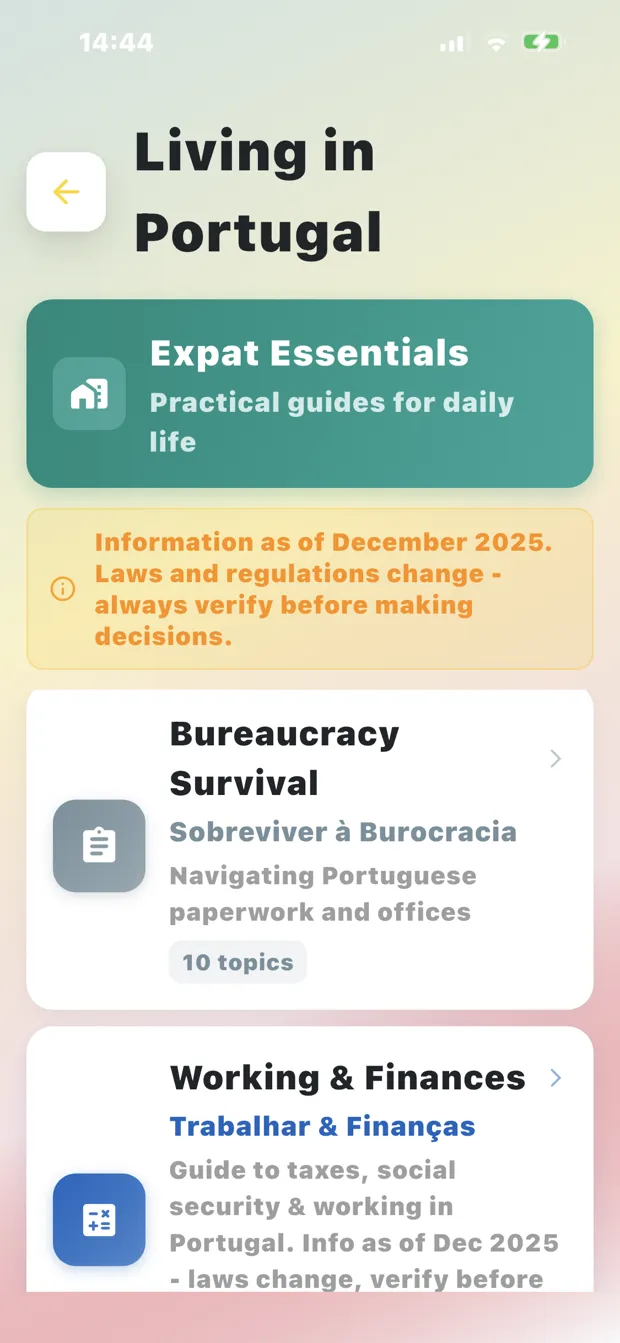
Everything after the paperwork is in Portuguese
Once the documents are done, daily life begins: AIMA, the town hall, the health centre, your landlord. Portugal Lifestyle Pro teaches European Portuguese with native Lisbon and Porto audio, structured A1 to C2, including the practical vocabulary for exactly those situations.
Download Free on the App Store Google Play Web App
Free download · 7-day free trial · 500+ lessons · Native Lisbon audio
On the App Store as Learn European Portuguese Pro
What should we build next?
This guide exists because someone asked for it. If there's a topic, lesson type or feature you want in Portugal Lifestyle Pro, tell us — it's five questions and takes about two minutes.
Share your ideas & feedback → No account needed · Email optional · We read every answer