Portuguese for the Citizenship Test: How to Pass CIPLE A2
To become a Portuguese citizen you must prove A2-level Portuguese. Most applicants do this via the CIPLE exam (Certificado Inicial de Português Língua Estrangeira). The good news: A2 is a genuinely achievable level — basic, practical Portuguese, not fluency.
What CIPLE tests
| Component | Time | Weight |
|---|---|---|
| Reading comprehension & writing | 1h15 | 45% |
| Listening comprehension | 30 min | 30% |
| Oral production (speaking) | ~15 min | 25% |
You pass with 55% or higher. You can sit the exam in Portugal or at CAPLE centres abroad — you don't need to be a resident.
The course alternative
Since 2024 you can skip the exam by proving A2 through an approved 150-hour course at an accredited centre. Useful if exams stress you out — but for most people, solid self-study plus the exam is faster and cheaper.
What A2 actually means in practice
A2 is described as "elementary" — and that's genuinely reassuring. You are not expected to discuss politics, use the subjunctive fluently, or understand fast group conversation. At A2 you need to:
- Understand common phrases about family, shopping, work and your local area
- Handle simple, routine exchanges — a shop, a doctor's appointment, an AIMA counter
- Describe your background, daily routine and immediate needs in simple terms
- Read short everyday texts: notices, messages, simple letters, forms
Roughly 1,000–1,500 common words covers A2 comfortably. That's an achievable target in months, not years.
How to prepare (and where people fail)
- Listening is the killer. The audio is natural-speed European Portuguese. If you trained with Brazilian materials, this section will sink you — the vowel reduction alone makes it feel like a different language. Train exclusively with Portugal-recorded audio. See why the variants differ.
- Writing is simple but must be practised. Short everyday texts — a message to a friend, filling in a simple form. Practise writing five sentences daily; that alone puts you ahead of most candidates.
- Speaking rewards rehearsed topics. The examiner will ask about predictable subjects. Prepare and drill these out loud beforehand.
- Don't skip the tu forms. Brazilian-focused courses barely teach them, but they appear throughout European Portuguese materials.
The speaking topics worth rehearsing
The oral component is predictable enough to prepare directly. Have two or three sentences ready on each of these:
- Yourself and your family (Chamo-me… Sou de… Tenho dois filhos…)
- Your job or studies (Trabalho como… Estudo…)
- Where you live and your neighbourhood (Moro em… Perto da minha casa há…)
- Your daily routine (De manhã… Depois… À noite…)
- Free time and hobbies (Gosto de… Nos fins de semana…)
- Why you came to Portugal (Vim para Portugal porque…)
- Shopping, food and simple transactions
Practise these aloud until they're automatic. Fluency on rehearsed topics reads as competence — see our conversation practice guide.
A realistic study plan
| Stage | Focus | Daily time |
|---|---|---|
| Months 1–2 | A1 foundations: greetings, numbers, present tense, core 500 words, Portugal-recorded audio every day | 20–30 min |
| Months 3–4 | A2 content: past tense, everyday scenarios, vocabulary to ~1,200 words, start speaking aloud daily | 25–30 min |
| Month 5 | Exam format: timed reading, listening at natural speed, short written texts | 30 min |
| Month 6 | Rehearse oral topics, mock papers, fix weak sections | 30 min |
From zero, 4–6 months of daily 20–30 minute sessions gets most people to a safe pass. Already conversational? Four weeks of exam-format practice is usually enough.
Registering for the exam
CIPLE is run by CAPLE (Centro de Avaliação de Português Língua Estrangeira), linked to the University of Lisbon. Exam sessions run several times a year at centres in Portugal and at approved centres abroad — you do not need to be resident in Portugal to sit it.
Registration closes weeks before each session and popular centres fill up, so book early rather than assuming a place will be free. Fees, dates and centre lists change from year to year — always confirm current details directly with CAPLE before planning around a date.
Who is exempt from the language requirement?
Some applicants don't need CIPLE at all. Exemptions generally include nationals of other Portuguese-speaking countries, and applicants who completed schooling in Portuguese. There are also accommodations available for applicants with certain disabilities or literacy circumstances.
Because these rules are applied case by case — and Portuguese nationality law was amended in 2026, including changes to the required residency period — confirm your own situation with AIMA or an immigration lawyer rather than relying on general guidance.
Common mistakes that cost people a pass
- Starting too late. The most common failure by far. People complete years of residency, then discover the language requirement with two months to go.
- Preparing with Brazilian Portuguese. You'll understand almost nothing in the listening section.
- Never practising under time pressure. The reading and writing paper is tight; candidates who've only studied casually run out of time.
- Studying silently. A quarter of your marks are for speaking. If you've never said a Portuguese sentence out loud, that's 25% at risk.
- Ignoring the writing component. It's simple, but only if you've written before. Five sentences a day is enough.
Frequently asked questions
What level of Portuguese do I need for citizenship?
A2 on the CEFR scale — elementary, practical Portuguese. It's normally proven with the CIPLE exam, or through an approved A2 course at an accredited centre.
How hard is the CIPLE exam?
It's an elementary-level exam and most prepared candidates pass. The pass mark is 55%, and listening is the section that catches people out — particularly anyone who studied Brazilian Portuguese.
How long does it take to prepare for CIPLE from scratch?
Typically 4–6 months at 20–30 minutes a day. Learners who already hold basic conversations often need only about a month of exam-format practice.
Can I take CIPLE outside Portugal?
Yes. CAPLE approves exam centres abroad, so many applicants sit it in their home country before or during the residency process.
Do I have to take an exam, or can I do a course instead?
Both routes exist. An approved A2 course at an accredited centre can satisfy the requirement instead of the exam. The exam is usually faster and cheaper; the course suits people who test badly under pressure.
Do it with Portugal Lifestyle Pro
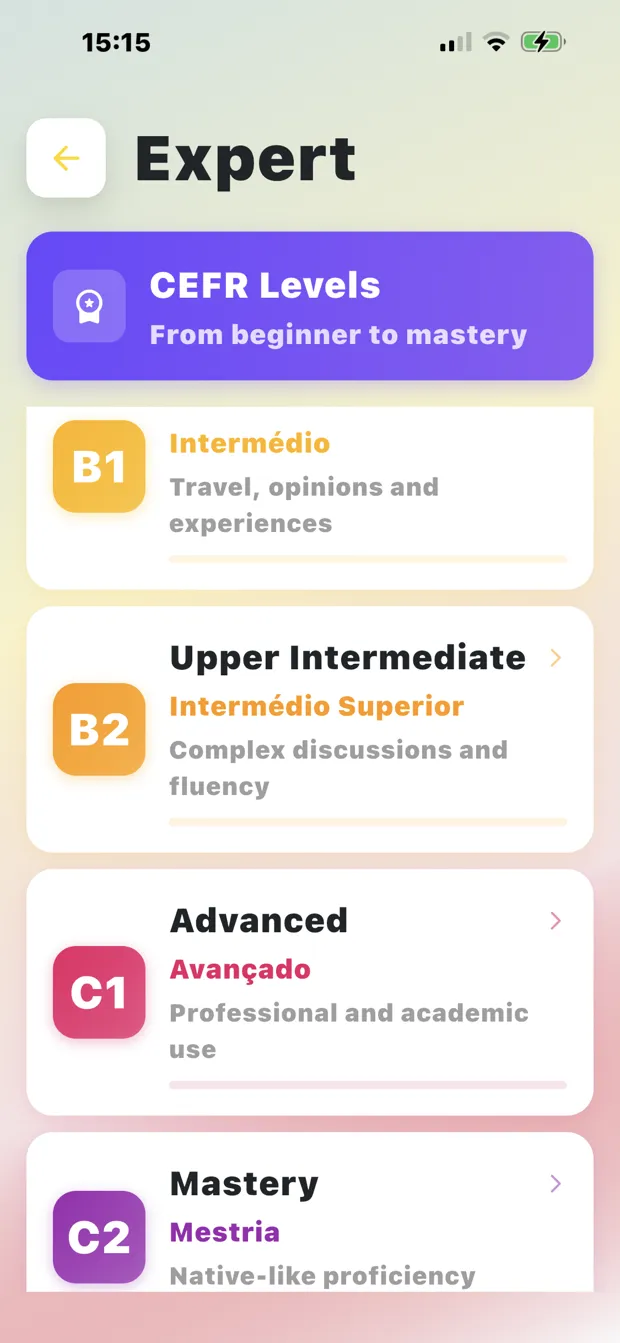
Portugal Lifestyle Pro's curriculum is CEFR-aligned, so the A1 and A2 modules map directly to CIPLE content. Use the native-audio lessons for the listening section, flashcards to hit the vocabulary target, the pronunciation test for oral prep, and Amigo AI to rehearse the speaking topics until they're automatic.
Download Free on the App Store Google Play Web App
Free download · 7-day free trial · 500+ lessons · Native Lisbon audio
On the App Store as Learn European Portuguese Pro
What should we build next?
This guide exists because someone asked for it. If there's a topic, lesson type or feature you want in Portugal Lifestyle Pro, tell us — it's five questions and takes about two minutes.
Share your ideas & feedback → No account needed · Email optional · We read every answer