Portugal Visa Guide: D7, D8, Golden Visa and the Path to Citizenship
Portugal still has some of Europe's most accessible residency routes, but the detail matters: which visa you pick decides your income threshold, how much time you must physically spend here, and how quickly you can apply for citizenship. This is a plain-English walkthrough of the main options and how they connect to the long game.
Rules change often, and they have changed a lot recently. Treat everything here as orientation, not advice — confirm your own situation with AIMA, your nearest Portuguese consulate, or an immigration lawyer before you commit money or book flights.
Which route fits you
| Route | Who it's for | Income or investment | Time in Portugal |
|---|---|---|---|
| D7 | Retirees, pensioners, anyone with stable passive income | Pegged to the Portuguese minimum wage | Substantial — it's a real residency |
| D8 | Remote employees and freelancers paid from abroad | Four times the minimum wage | Substantial |
| Golden Visa | Investors wanting a plan-B residency | From €250,000 | About seven days a year |
| D1 / D2 / D3 | Employees, entrepreneurs, highly qualified staff | Job offer or business plan | Substantial |
| CPLP | Nationals of Portuguese-speaking countries | Simplified requirements | Substantial |
D7 — the passive income visa
The classic retirement route, and still the most used. It is for people whose money arrives without them working for it: a pension, rental income, dividends, royalties, or income from a business you don't actively run.
The income threshold is tied to the Portuguese national minimum wage, which means it rises every January — check the current figure before you apply rather than trusting a blog post from last year. On top of the base amount you need roughly 50% more for a spouse and 30% more per dependent child. Consulates also want to see savings in a Portuguese bank account, typically a year's worth of that income, and they care that the income is stable and recurring — twelve months of statements showing the same amount arriving beats one large lump sum.
The permit runs two years initially, then renews for three, then three again. After five years of legal residence you can apply for permanent residency.
D8 — the digital nomad visa
Introduced for remote workers paid by companies outside Portugal. The threshold is four times the minimum wage — in the region of €3,000 a month — which is the main thing separating it from the D7.
It comes in two forms, and people confuse them constantly. The temporary stay visa lasts up to a year and does not lead anywhere; the residency visa is the one that starts your clock toward permanent residency and citizenship. If the long game matters to you, apply for the residency version.
You will need an employment contract or client contracts proving the work is genuinely foreign-sourced, plus the same proof of accommodation and clean criminal record every route requires.
Golden Visa — what's left of it
The property route closed in 2023. Any article still telling you to buy an apartment for residency is out of date. What remains:
- Investment fund subscription, from €500,000
- Cultural or artistic donation, from €250,000
- Creating ten or more jobs in Portugal
Its real appeal was never the investment — it is the stay requirement. You keep residency on roughly seven days a year in Portugal, which no other route allows. That makes it a plan-B passport strategy rather than a moving-here strategy. Note the catch: minimal physical presence still counts as legal residence for the citizenship clock, which is precisely why the programme attracts political attention.
Work visas: D1, D2 and D3
The D1 is for employees with a Portuguese job offer. The D2 is for entrepreneurs and independent workers, and needs a credible business plan — it is the route most freelancers who want local clients end up on. The D3 is for highly qualified professionals and is usually faster, because the employer is doing the pushing.
CPLP — the route people forget
Nationals of the Community of Portuguese Language Countries — Brazil, Angola, Mozambique, Cape Verde, Guinea-Bissau, São Tomé and Príncipe, East Timor and Equatorial Guinea — have a simplified residence route with lighter requirements than the standard visas. If you hold one of these nationalities, ask about it explicitly before starting a D7 or D8 application. It is routinely overlooked.
Family reunification
Once you hold a residence permit, spouses, minor children and dependent parents can join you. You will need the birth or marriage certificate apostilled and translated into Portuguese, proof your accommodation is large enough, and proof you can support them. Start gathering these documents early — see our apostille and translation guide, because this is where most family applications stall.
The process, and how long it really takes
- Get a NIF (tax number). Everything else depends on it. You can get one through your consulate or a fiscal representative before you arrive.
- Open a Portuguese bank account and move the required funds in.
- Apply at the consulate in your country of residence, with apostilled documents.
- Fly in on the visa, which is valid for a limited window.
- Attend your AIMA appointment for biometrics and documents.
- Receive your residence card, then renew on schedule.
| Stage | Realistic wait |
|---|---|
| Consulate appointment | 1–4 months |
| Visa processing | 2–8 weeks |
| AIMA appointment after arrival | 1–6 months |
| AIMA processing | 2–4 months |
| Card delivery | 2–4 weeks |
| Total | 6–18 months |
AIMA appointments are the bottleneck. Lisbon and Porto have the longest queues; Braga, Coimbra and Évora move faster. Slots get released unpredictably, so check often rather than once.
The path to citizenship — and what changed in 2026
This is the part that changed, and it changes the maths for anyone planning a move.
Portugal's parliament voted in April 2026 to extend the residency requirement for citizenship. The dividing line is 1 January 2026: people who were already legally resident before that date are treated under the old five-year rule, while new arrivals face ten years. The legislation was still moving through its final stages when it was passed, so confirm the current position before you plan around either number — this is the single most consequential detail on this page and the one most likely to be out of date.
Whichever clock applies, the other requirements are stable: a clean criminal record in Portugal and your country of origin, demonstrable ties to Portugal, financial self-sufficiency, and A2 Portuguese, normally proven through the CIPLE exam.
One route bypasses the residency clock entirely: citizenship by descent. If you have a Portuguese parent or grandparent you may qualify regardless of where you have lived. If there is any Portuguese branch in your family tree, investigate that first — it is dramatically faster than any visa.
Mistakes that cost people months
- No NIF before arriving. Nothing else can start without it.
- Criminal record not apostilled and translated. The single most common rejection.
- Lease not registered with Finanças. An unregistered lease is not valid proof of address for AIMA.
- Turning up with one copy. Bring originals plus two photocopies of everything.
- No health insurance certificate. Required for most routes.
- Leaving the language to the end. See below.
Common questions
Which Portuguese visa is easiest to get?
For most people with savings or a pension, the D7 — its income threshold is the lowest of the residency routes and it does not require a job offer or a business plan. If you are employed remotely by a foreign company and earn above four times the minimum wage, the D8 residency visa is equally straightforward and better suited to your situation.
Can I still get a Portuguese Golden Visa by buying property?
No. The real estate route was closed in 2023. The remaining options are an investment fund subscription from €500,000, a cultural or artistic donation from €250,000, or creating ten or more jobs in Portugal.
How many years of residence do I need for Portuguese citizenship?
Parliament voted in April 2026 to extend the requirement from five years to ten. People who were already legally resident before 1 January 2026 fall under the five-year rule; new arrivals face ten. Because the change was recent, confirm the current position with AIMA or an immigration lawyer before planning around either figure.
Do I need to speak Portuguese to get a visa?
No — none of the residency visas require a language test. Portuguese becomes compulsory at the citizenship stage, where you must prove A2 level, usually through the CIPLE exam. The gap between those two points is exactly why so many people start too late.
How long does the whole process take?
From first consulate appointment to residence card in hand, six to eighteen months is realistic. AIMA appointment availability is usually the bottleneck rather than any processing step.
Start the language now, not later
Whatever route you choose, the smartest move is starting Portuguese during the application itself. You are going to spend months waiting regardless — that is enough time to reach A1 or solid A2 before you land, which makes your AIMA appointment, your first lease and your first year immeasurably easier. And if citizenship is the destination, the A2 requirement is waiting for you at the end whether you prepared for it or not.
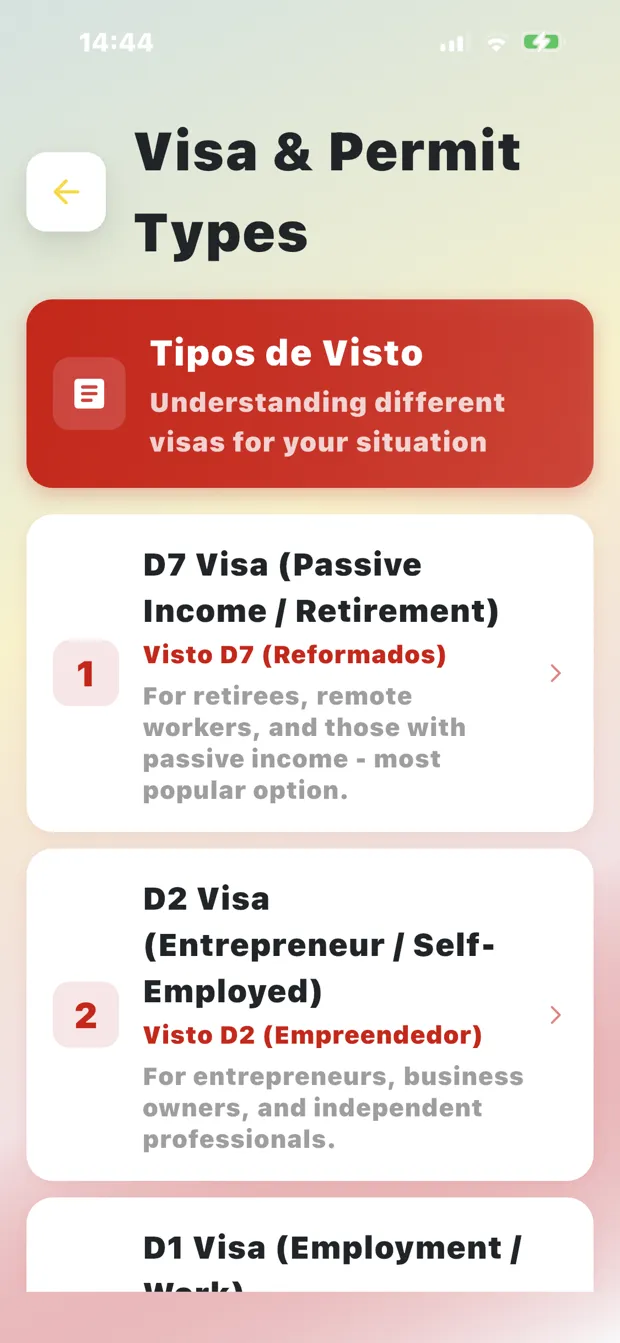
Do it with Portugal Lifestyle Pro
Portugal Lifestyle Pro includes a built-in AIMA immigration guide — appointment process, required documents, key vocabulary like agendamento and comprovativo de morada — alongside the CEFR course that takes you to the A2 citizenship level. The whole journey, one app.
Download Free on the App Store Google Play Web App
Free download · 7-day free trial · 500+ lessons · Native Lisbon audio
On the App Store as Learn European Portuguese Pro
What should we build next?
This guide exists because someone asked for it. If there's a topic, lesson type or feature you want in Portugal Lifestyle Pro, tell us — it's five questions and takes about two minutes.
Share your ideas & feedback → No account needed · Email optional · We read every answer