How to Apply for a Portugal Visa from Asia
The visa itself is rarely the hard part. What trips people up is the application process: booking a slot, assembling a document pack that satisfies one specific consulate, and getting apostilles and translations done in the right order.
Before you rely on any of this: Portuguese immigration rules change often, and they changed substantially in 2024 and again in 2026. Requirements also differ by consulate and by nationality. Treat this as orientation, then confirm your own case with the Portuguese consulate that covers you, with AIMA, or with a qualified immigration lawyer. Nothing here is legal advice.
Where you apply
You apply to the Portuguese consulate with jurisdiction over your place of residence — not whichever one is most convenient. Applying to the wrong consulate is a common and entirely avoidable rejection.
In several Asian countries, Portugal outsources appointment booking and document collection to an external provider such as VFS Global. The provider takes your documents and biometrics; the consulate still makes the decision. Where a provider is used, you generally cannot bypass it.
Check the website of the Portuguese embassy or consulate covering your country for the current arrangement, since providers and procedures change.
The application, step by step
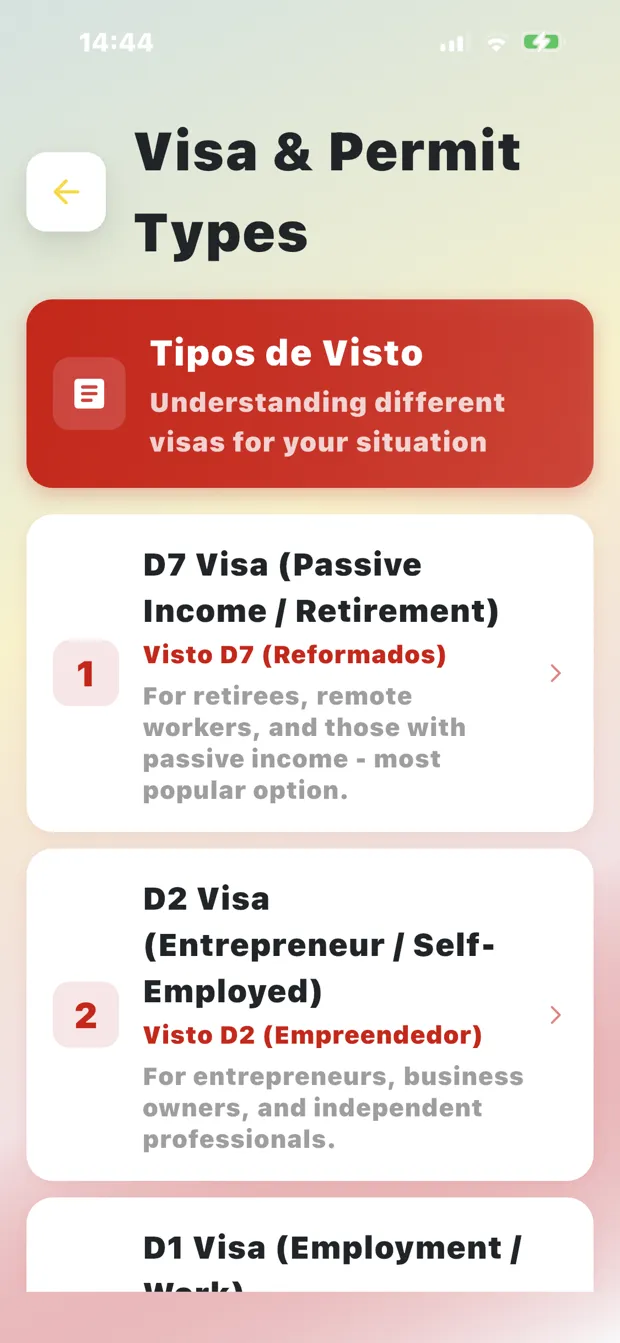
- Identify your visa type. D1 work, D2 entrepreneur, D3 highly qualified, D4 study, D6 family reunification, D7 passive income, D8 remote work.
- Assemble documents and get apostilles and certified translations done. Start here — it is the long pole.
- Complete the application form and gather photographs to specification.
- Book the appointment. Slots at busy consulates can be weeks or months out, so book as soon as documents are close to ready.
- Attend, submit and give biometrics. Bring originals as well as copies.
- Pay the fee — the visa fee, plus any provider service charge.
- Wait for the decision, then collect your passport with the visa.
- Travel within the visa's validity window and attend your AIMA appointment in Portugal.
What goes in the pack
| Document | Notes |
|---|---|
| Passport | Validity well beyond the stay, plus blank pages |
| Application form | Signed, matching your passport exactly |
| Photographs | To the consulate's stated specification |
| Criminal record certificate | Apostilled and translated; short validity window |
| Proof of accommodation | Lease, deed or equivalent |
| Proof of means | Bank statements, contract, pension or income evidence |
| Health insurance | Valid in Portugal for the initial period |
| Route-specific evidence | Employment contract, enrolment letter, client contracts, income proof |
| Consent form | Permission for a Portuguese criminal record check |
Assume every foreign-language document needs a certified Portuguese translation. Some consulates accept English for certain items, but do not build your plan on that.
Six mistakes that cause rejections and delays
- Expired criminal record certificates. They have short validity. Get them late in the process, not first.
- Missing apostilles. A notarised copy is not the same thing. See the apostille guide.
- Name mismatches. Passport, certificates and bank records must agree. Where naming conventions differ from Portuguese ones — patronymics, single names, transliterations — consulates ask questions. An affidavit of name equivalence resolves it.
- Thin proof of means. One large recent deposit looks worse than six months of steady balance.
- Vague accommodation evidence. A two-week hotel booking is not proof of accommodation for a residence visa.
- Booking travel before approval. Never buy non-refundable flights before the visa is in your passport.
Fees and timelines
There is a consulate visa fee, and where an external provider is used, a separate service charge. Apostilles, translations and certificates all add up, and for a family the total climbs quickly.
Processing times vary widely by consulate, visa type and season. Published targets exist but are not guarantees. A realistic planning assumption is several weeks to several months from submission to decision, on top of however long documents and appointments take.
Because both fees and timelines change, confirm current figures directly with your consulate rather than relying on any number you read online, including here.
After approval
Your visa allows you to enter Portugal. It is not your residence permit. Once in the country you attend an AIMA appointment where biometrics and documents are taken again, and the residence permit card is issued from there.
That appointment runs in Portuguese. Officials are generally patient, but going in able to understand basic questions about your address, your work and your family makes a real difference — and A2 Portuguese is required later for permanent residency and citizenship anyway.
Frequently asked questions
Where do I apply for a Portugal visa if I live in Asia?
You apply to the Portuguese consulate with jurisdiction over your place of residence. In several Asian countries appointment booking and document collection are handled by an external provider such as VFS Global, though the consulate still makes the decision. Check the relevant embassy website for current arrangements.
How long does a Portugal visa take to process?
It varies considerably by consulate, visa type and season. A realistic planning assumption is several weeks to several months from submission, on top of the time needed to gather documents and secure an appointment. Confirm current timelines with your consulate.
Why do Portugal visa applications get rejected?
Common causes include expired criminal record certificates, missing apostilles, name mismatches across documents, insufficient proof of means of subsistence, weak accommodation evidence, and applying to the wrong consulate for your area of residence.
Do I need a certified translation of my documents for a Portugal visa?
Generally yes. Assume every foreign-language document needs a certified Portuguese translation. Some consulates accept English for certain items, but you should not build your application plan around that assumption.
Is a Portugal visa the same as a residence permit?
No. The visa allows you to enter Portugal. Once there you attend an AIMA appointment where biometrics and documents are taken again, and your residence permit card is issued from that process.
Prepare for the AIMA counter
Your AIMA appointment runs in Portuguese. Portugal Lifestyle Pro teaches European Portuguese with native Lisbon and Porto audio and includes practical vocabulary for immigration appointments, health centres and town halls, plus the full CEFR path to the A2 level residency and citizenship require.
Download Free on the App Store Google Play Web App
Free download · 7-day free trial · 500+ lessons · Native Lisbon audio
On the App Store as Learn European Portuguese Pro
What should we build next?
This guide exists because someone asked for it. If there's a topic, lesson type or feature you want in Portugal Lifestyle Pro, tell us — it's five questions and takes about two minutes.
Share your ideas & feedback → No account needed · Email optional · We read every answer