Working in Portugal as a Non-EU Citizen
Portugal has an ageing population and real labour shortages, particularly in technology, healthcare, hospitality, construction and agriculture. For non-EU nationals that means genuine opportunity — but the routes are specific, and you cannot simply arrive and look for work without the right visa.
Before you rely on any of this: Portuguese immigration rules change often, and they changed substantially in 2024 and again in 2026. Requirements also differ by consulate and by nationality. Treat this as orientation, then confirm your own case with the Portuguese consulate that covers you, with AIMA, or with a qualified immigration lawyer. Nothing here is legal advice.
The work routes
| Route | Who it fits | Key requirement |
|---|---|---|
| D1 — subordinate work | You have a job offer from a Portuguese employer | A signed employment contract or promise of one |
| D2 — independent / entrepreneur | Freelancers, self-employed, business founders | Business plan, contracts or proof of activity, plus means |
| D3 — highly qualified | Specialists, senior technical and academic roles | Qualification or experience, plus a qualifying salary level |
| Job seeker visa | You want to come and look for work | Means of support; a limited stay to find a job and then convert |
| D8 — remote work | You keep foreign clients or employer | Foreign income above the required threshold |
The job seeker visa is the one people miss. It lets you enter legally to search, rather than gambling on a tourist entry, which no longer leads anywhere since the 2024 rule change. It has a limited duration, so arrive with a plan and applications already in progress.
The two numbers you need
- NIF (número de identificação fiscal) — your tax number, from Finanças. Needed for a contract, a lease, a bank account, a phone. Non-residents usually need a fiscal representative to obtain one.
- NISS (número de identificação de segurança social) — your social security number. Required to be employed legally and to access benefits and healthcare contributions.
Both are free to obtain. Be wary of services charging large fees for what is a straightforward administrative step, though a fiscal representative is a legitimate cost if you genuinely need one.
Getting foreign qualifications recognised
Whether you need formal recognition depends entirely on your field:
- Regulated professions — doctors, nurses, lawyers, engineers, teachers, architects — require recognition by the relevant Portuguese professional body before you can practise. This can be lengthy and often includes a Portuguese language requirement well above A2.
- Academic recognition of a foreign degree is handled through the Portuguese higher education system, either as a general equivalence or a specific one.
- Unregulated fields — most technology, business and hospitality roles — usually need no formal recognition. Your employer decides.
If you are in a regulated profession, start recognition before you move. It is the single most common reason qualified people end up working below their level for a year or more after arriving.
Salaries, and being realistic
Portuguese salaries are low by northern European and North American standards, and that surprises people who focused on the cost of living. Lisbon and Porto pay more than the interior, and technology pays well above the national average, but the gap between local pay and local housing costs in Lisbon is a genuine strain.
Two things worth checking before accepting an offer: whether the salary meets any threshold your visa route requires, and what it looks like after tax and social security contributions rather than gross.
Your rights at work
Once legally employed, non-EU workers hold broadly the same protections as Portuguese workers: written contracts, a minimum wage, paid holiday, limits on working hours, and social security coverage. Portugal has a strong statutory framework here.
If an employer proposes paying you without a contract, or without registering you for social security, that is not a shortcut — it leaves you with no residency evidence, no contributions and no protection, and it can damage a later residency or citizenship application.
The language reality
English is workable in international technology companies, tourism and parts of Lisbon. Almost everywhere else, work happens in Portuguese — construction sites, restaurant kitchens, hospitals, agriculture, logistics, and any customer-facing role.
Beyond the job itself, Portuguese decides how quickly you stop being an outsider: the team conversation at lunch, the union rep, the HR form, the contract you are signing. And the same A2 level comes back for permanent residency and citizenship.
Regulated professions typically need considerably more than A2, so if that is your path, treat language as part of the qualification process rather than something to handle afterwards.
Frequently asked questions
Can a non-EU citizen work in Portugal?
Yes, with the appropriate visa. The main routes are the D1 for those with a job offer, the D2 for freelancers and entrepreneurs, the D3 for highly qualified activity, the job seeker visa for those wanting to look for work, and the D8 for remote workers with foreign income.
What is the Portugal job seeker visa?
It allows non-EU nationals to enter Portugal legally to look for work, rather than arriving as a tourist. It has a limited duration and requires proof of means of support, and it can be converted once you find employment. It matters more since the 2024 closure of in-country regularisation.
Do I need my degree recognised to work in Portugal?
It depends on the field. Regulated professions such as medicine, nursing, law, engineering and teaching require recognition by the relevant Portuguese professional body, often with a language requirement above A2. Most technology, business and hospitality roles need no formal recognition.
What are NIF and NISS in Portugal?
The NIF is your tax identification number from Finanças, needed for contracts, leases and bank accounts. The NISS is your social security number, required to be employed legally. Both are free to obtain, though non-residents often need a fiscal representative for the NIF.
Do I need Portuguese to work in Portugal?
In international technology companies, tourism and parts of Lisbon, English is often workable. Most other workplaces operate in Portuguese, including construction, hospitality, healthcare and customer-facing roles. A2 Portuguese is also required later for permanent residency and citizenship.
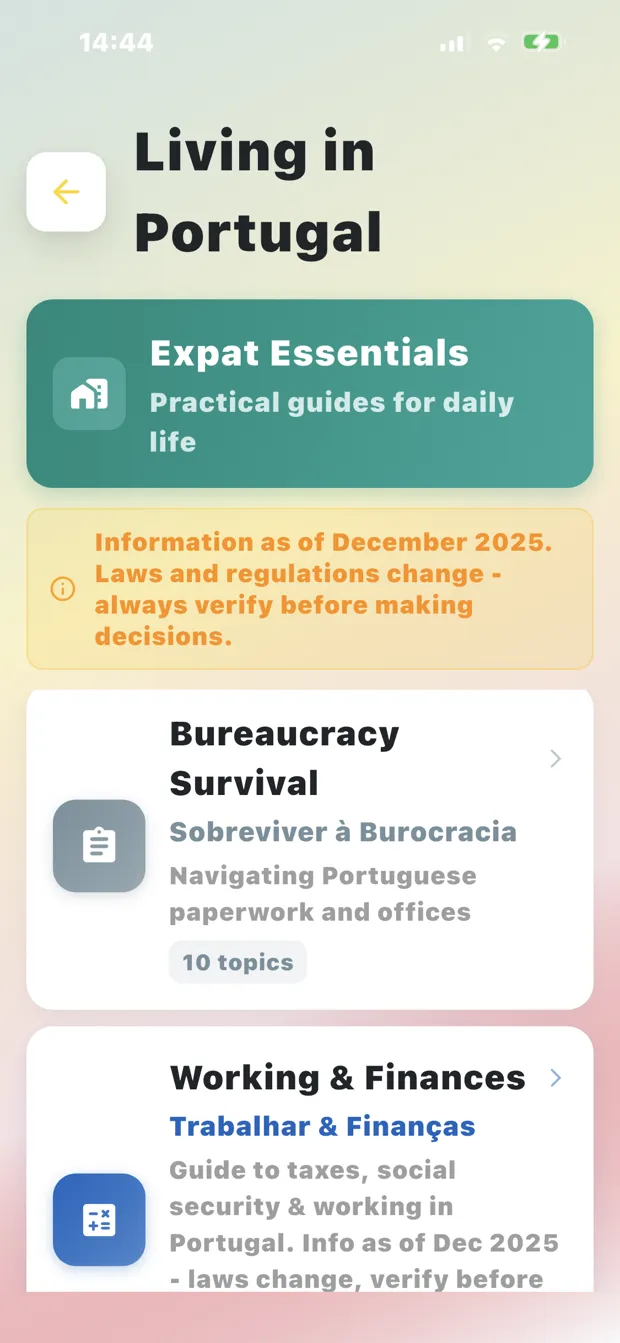
Portuguese is what gets you off the bottom rung
Outside international tech and tourism, work in Portugal happens in Portuguese. Portugal Lifestyle Pro teaches European Portuguese with native Lisbon and Porto audio, structured A1 to C2, so you can follow the team conversation, read your own contract and reach the A2 level residency requires.
Download Free on the App Store Google Play Web App
Free download · 7-day free trial · 500+ lessons · Native Lisbon audio
On the App Store as Learn European Portuguese Pro
What should we build next?
This guide exists because someone asked for it. If there's a topic, lesson type or feature you want in Portugal Lifestyle Pro, tell us — it's five questions and takes about two minutes.
Share your ideas & feedback → No account needed · Email optional · We read every answer