Portuguese for Chinese Speakers: What's Hard and What Isn't
Portuguese and Chinese are about as structurally distant as two languages get. Chinese verbs never change form; Portuguese verbs change constantly. Chinese has no grammatical gender and no articles; Portuguese has both on almost every noun. None of that makes Portuguese unlearnable, but it does mean the standard advice written for English speakers misses what actually slows Chinese speakers down.
The short version: the hard parts are verb conjugation, grammatical gender and the European Portuguese sound system. The good news is that Portuguese word order is close to Chinese, there are no tones to master, and if your goal is Macau, Portugal or Lusophone business, European Portuguese is the variant you want.
Why Chinese speakers learn Portuguese
The motivations are usually one of four, and they point to different variants:
- Macau. Portuguese remains an official language of the Macau SAR alongside Chinese, used in law and government. Legal and administrative Portuguese there follows the European standard.
- Lusophone trade. Macau hosts the Forum for Economic and Trade Co-operation between China and Portuguese-speaking Countries, and Portuguese is taught at a growing number of mainland Chinese universities.
- Study or residency in Portugal. Portugal is a popular destination for Chinese students and investors, and residency eventually raises the A2 language requirement for citizenship.
- Brazil business. The one case where Brazilian Portuguese is the right choice.
If your target is Portugal or Macau, learning Brazilian Portuguese is a costly detour — the accent, vocabulary and pronoun placement all differ.
The four genuinely hard parts
1. Verb conjugation
This is the biggest single leap. In Chinese, 我去 / 你去 / 他去 all use 去 unchanged, with time expressed by context or particles. Portuguese changes the verb for person and tense:
| Chinese | Portuguese | English |
|---|---|---|
| 我去 | eu vou | I go |
| 你去 | tu vais | you go |
| 他去 | ele vai | he goes |
| 我们去 | nós vamos | we go |
| 我去了 | eu fui | I went |
Note the tu form. Portugal uses tu constantly in informal speech, and courses built around Brazilian Portuguese barely teach it. Treat conjugation as daily drilling rather than something to understand once — see the verb conjugation guide.
2. Gender and articles
Every Portuguese noun is masculine or feminine, and articles and adjectives must agree: o carro branco, a casa branca. Chinese has neither feature.
The fix is mechanical: never learn a noun without its article. Learn o comboio, not comboio. Learn a mesa, not mesa. If you store the article with the word from day one, gender becomes automatic instead of a separate memorisation task later.
3. The sound system
Mandarin syllables end in a vowel or in -n / -ng. Portuguese ends syllables in -s, -r, -l and stacks consonants together, which produces the most common pronunciation difficulties:
| Feature | Difficulty | Example |
|---|---|---|
| Final -s as "sh" | New sound in final position | os livros → "ush LEE-vrush" |
| Guttural R | No Mandarin equivalent | carro, rua |
| Tapped r vs guttural R | Meaning-changing pair | caro (expensive) vs carro (car) |
| /v/ | Absent from standard Mandarin | vinho, viver |
| Consonant clusters | Tendency to insert vowels | problema, quatro |
| Nasal vowels | Different from -n / -ng | pão, mãe, bem |
| Vowel reduction | Unstressed vowels vanish | telefone → "tlefon" |
That last row is the defining feature of European Portuguese and the reason learners who trained on Brazilian audio can't follow conversation in Lisbon. Our pronunciation guide covers each sound.
4. Not carrying tones across
Portuguese is not tonal. Pitch changes carry emotion and question intonation, not lexical meaning. Mandarin speakers sometimes apply tone-like contours to individual Portuguese words, which sounds unusual to native ears. Portuguese rhythm instead runs on stress: one syllable per word carries weight and the rest reduce around it.
What is easier than you expect
- Word order. Both languages are broadly subject-verb-object. Eu como arroz maps directly onto 我吃饭. Japanese and Korean speakers have a harder time here.
- No tones to learn. A significant reduction in listening load compared with what you already handle.
- Alphabetic writing. 26 letters with fairly consistent spelling-to-sound rules. Reading becomes usable far faster than character learning.
- Plurals are simple. Usually just add -s or -es, with none of the classifier system Chinese requires (个, 本, 张).
- Pinyin experience helps. If you learned pinyin, you already have the habit of mapping Latin letters to sounds.
A study plan that fits these difficulties
| Stage | Priority |
|---|---|
| Months 1–2 | Sounds first. Portugal-recorded audio daily. Learn every noun with its article. Present tense of ser, estar, ter, ir, fazer. |
| Months 3–4 | Past tense. Vocabulary to about 1,000 words. Start speaking aloud daily, even alone. |
| Months 5–6 | Everyday scenarios: café, pharmacy, shops. Listening at natural speed. A2 target reached by most learners here. |
| Beyond | Pronoun placement, subjunctive, and the register differences between tu, você and o senhor. |
One habit worth borrowing from character study: spaced repetition. The same discipline that works for hanzi works extremely well for Portuguese vocabulary and conjugation — with one addition, which is that every card should carry audio.
The culture gap, and why it matters as much as the grammar
Vocabulary gets you understood. Cultural fluency is what stops you being read as a tourist indefinitely. Several everyday Portuguese norms differ sharply from Chinese ones:
| Situation | What surprises Chinese newcomers |
|---|---|
| Meal times | Lunch runs 12:30–14:30 and dinner rarely starts before 20:00. Arriving for dinner at 18:00 means an empty restaurant. |
| Greetings | Business is a handshake, but socially people exchange beijinhos, two kisses on the cheek. Men usually shake hands with each other. |
| Coffee | An espresso taken standing at the counter in two minutes, several times a day. Not a sit-down social event. |
| Directness | Portuguese people are warm but say what they mean. There is far less indirect circumlocution to preserve face than Chinese conversation often uses. |
| Relationships | Personal trust matters in business much as guanxi does, but it is built over long lunches and coffees rather than formal banquets and gift exchange. |
| Punctuality | Social timekeeping is relaxed. Arriving 15 minutes late to a dinner is normal. Business meetings are stricter. |
There's also a concept worth learning early: saudade, a particular kind of longing for something absent, and one of the most quoted untranslatable words in Portuguese. It runs through fado music and turns up constantly in ordinary speech.
Learning culture alongside the language is one of the reasons Portugal Lifestyle Pro includes culture stories and district guides rather than only lessons. Our Portuguese culture guide and food guide cover the rest.
Frequently asked questions
Is Portuguese hard for Chinese speakers?
The main difficulties are verb conjugation, grammatical gender and articles, none of which exist in Chinese, plus European Portuguese pronunciation. Offsetting that, word order is broadly the same as Chinese, there are no tones, and the alphabet makes reading accessible quickly. Most learners reach A2 in about six months of daily study.
Should Chinese speakers learn European or Brazilian Portuguese?
It depends on the goal. For Macau, Portugal, study or residency in Portugal, learn European Portuguese, since Macau's administrative and legal Portuguese follows the European standard. Only choose Brazilian Portuguese if your focus is business with Brazil.
Is Portuguese still spoken in Macau?
Yes. Portuguese remains an official language of the Macau Special Administrative Region alongside Chinese, and is used in law and government. Macau also hosts the Forum for Economic and Trade Co-operation between China and Portuguese-speaking Countries.
What is the hardest part of Portuguese for Mandarin speakers?
Verb conjugation is usually the biggest structural challenge, because Chinese verbs never change form while Portuguese verbs change for both person and tense. In pronunciation, the guttural R, the /v/ sound, final consonants and European Portuguese vowel reduction cause the most trouble.
How long does it take a Chinese speaker to learn Portuguese?
With 20 to 30 minutes of daily practice, most learners reach A2, meaning functional everyday conversation, in about four to six months. Reaching B1 typically takes around a year. Consistency matters far more than long occasional sessions.
Built for European Portuguese, not Brazilian
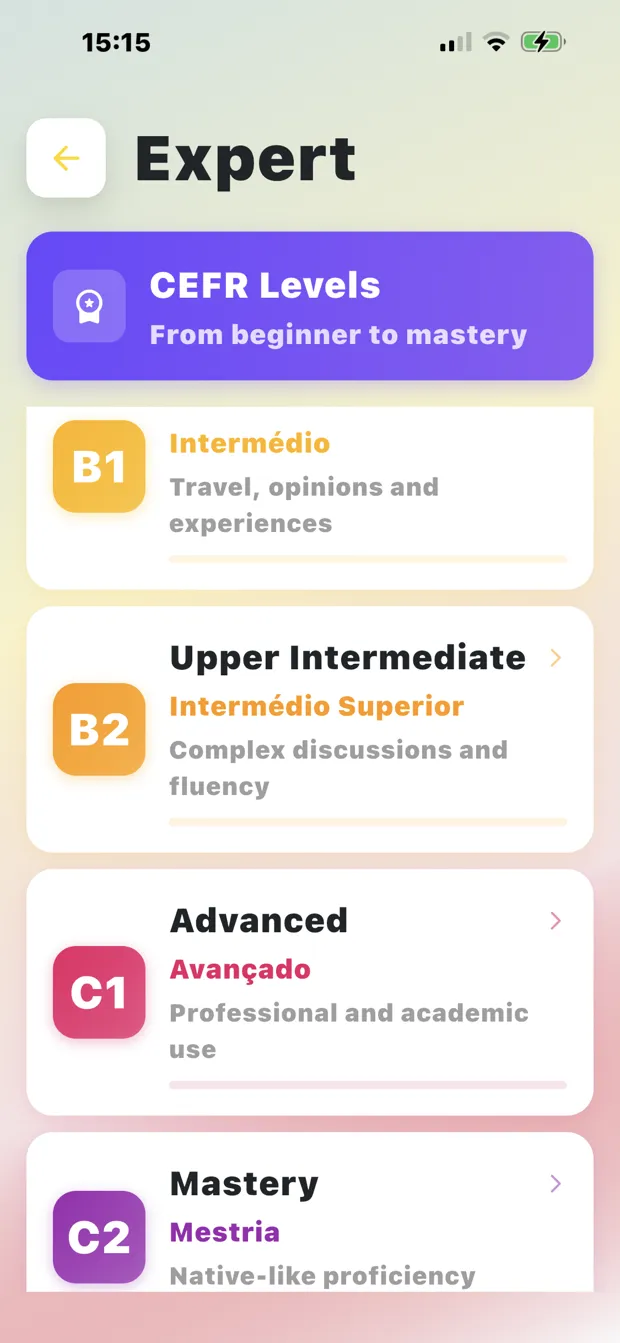
If your goal is Macau or Portugal, the variant matters. Portugal Lifestyle Pro teaches European Portuguese only, with native audio recorded in Lisbon and Porto, full CEFR levels from A1 to C2, verb conjugation drills and a pronunciation trainer for the sounds Mandarin does not have.
Download Free on the App Store Google Play Web App
Free download · 7-day free trial · 500+ lessons · Native Lisbon audio
On the App Store as Learn European Portuguese Pro
What should we build next?
This guide exists because someone asked for it. If there's a topic, lesson type or feature you want in Portugal Lifestyle Pro, tell us — it's five questions and takes about two minutes.
Share your ideas & feedback → No account needed · Email optional · We read every answer