Portuguese for Japanese Speakers: The 450-Year Head Start
Japanese speakers start with an advantage almost nobody mentions: you already know dozens of Portuguese words. Portuguese missionaries and traders reached Japan in 1543, the first Europeans to do so, and the vocabulary they left behind is still in daily use.
That history is charming, but the practical picture is mixed. Word order, consonant clusters and the L/R distinction are real obstacles. Here's what actually matters.
The words you already know
These everyday Japanese words came from Portuguese:
| Japanese | From Portuguese | Meaning |
|---|---|---|
| パン (pan) | pão | bread |
| タバコ (tabako) | tabaco | tobacco |
| ボタン (botan) | botão | button |
| コップ (koppu) | copo | cup / glass |
| カッパ (kappa) | capa | raincoat |
| シャボン (shabon) | sabão | soap |
| ビロード (birōdo) | veludo | velvet |
| フラスコ (furasuko) | frasco | flask |
| カステラ (kasutera) | (pão de) Castela | sponge cake |
| ジュバン (juban) | gibão | undergarment |
The tempura connection is debated but widely attributed to Portuguese missionaries and the Latin quatuor tempora, the ember days when meat was avoided and fish was fried instead. Either way, the borrowing runs deep: these words entered Japanese four centuries before English loanwords arrived in volume.
The three genuine difficulties
1. Word order
Japanese is subject-object-verb, with the verb at the end. Portuguese is subject-verb-object.
| Japanese structure | Portuguese | English |
|---|---|---|
| 私はパンを食べます (I bread eat) | Eu como pão | I eat bread |
| 彼は本を読みます (He book reads) | Ele lê um livro | He reads a book |
Related: Japanese marks roles with particles after the word (は, を, に, で), while Portuguese uses prepositions before it and relies on position. Retraining the instinct to hold the verb until the end takes deliberate speaking practice, not reading.
2. Consonant clusters and syllable structure
Japanese is mora-timed and built mostly from consonant-vowel syllables. Portuguese stacks consonants and ends syllables with them, which produces a predictable tendency to insert extra vowels:
- problema risks becoming "puroburema"
- quatro risks becoming "kuatoro"
- livros risks becoming "riburosu"
The drill that works is slow, deliberate repetition of clusters without inserting vowels, then gradually speeding up. Recording yourself and comparing against native audio is the fastest corrective.
3. L and R
Japanese has a single liquid sound, so the Portuguese contrast between l and r needs building from scratch. Portuguese makes it harder by having two r-sounds, and the difference changes meaning:
| Word | Sound | Meaning |
|---|---|---|
| caro | single tapped r | expensive |
| carro | strong guttural R | car |
| calo | l | callus |
Treat these as three distinct sounds and drill them as minimal pairs from the first week rather than hoping they resolve later.
What Japanese speakers find easier
- The five vowels. Japanese a, i, u, e, o map closely onto Portuguese's basic vowels — a real advantage over English speakers, who struggle with vowel purity.
- Politeness registers. Portuguese distinguishes tu (informal), você and o senhor / a senhora (formal). After keigo, this feels straightforward — and Portugal genuinely uses these distinctions, unlike Brazil where você dominates.
- Study discipline. The habits that work for kanji — spaced repetition, daily consistency, accepting slow accumulation — transfer perfectly.
- Katakana intuition. You already parse foreign words phonetically, which helps with new vocabulary.
One warning about katakana: it can also interfere. Reading Portuguese words through katakana phonology reinforces the inserted-vowel habit. Learn new words from audio rather than from a katakana transcription.
European or Brazilian Portuguese?
Japan's connection to Portuguese today mostly runs through Brazil. Brazil has the largest Japanese diaspora in the world, and many Japanese-Brazilians have moved to Japan for work, so Brazilian Portuguese is what most Japanese people encounter.
That makes the choice a real decision rather than a default. If your goal is Brazil, or communicating with the Brazilian community in Japan, learn Brazilian Portuguese. If your goal is Portugal — study, work, residency, or eventually the A2 citizenship requirement — learn European Portuguese. The differences in pronunciation, vocabulary and pronoun placement are substantial.
A realistic study plan
| Stage | Priority |
|---|---|
| Months 1–2 | Minimal pairs for l / r / rr from day one. Consonant clusters without inserted vowels. Nouns learned with their articles. |
| Months 3–4 | Subject-verb-object order through speaking, not reading. Present and past tense of the core verbs. |
| Months 5–6 | Natural-speed listening, everyday scenarios, roughly 1,000 words. A2 within reach. |
Prioritise speaking earlier than feels comfortable. The word-order instinct and the consonant clusters are both motor habits, and neither improves through reading alone.
The culture gap, and where Japan and Portugal quietly agree
Some of the adjustment is sharp, and some of it is surprisingly familiar.
| Situation | What differs from Japan |
|---|---|
| Greetings | Beijinhos, two kisses on the cheek, replace the bow in social settings. Physical contact in conversation is normal and friendly. |
| Punctuality | Far more relaxed. Social events start late and trains are not measured against the second. |
| Conversation | Overlapping speech and interruption signal engagement, not rudeness. Comfortable silence is much rarer than in Japan. |
| Meals | Dinner starts around 20:00 and lasts. Lingering at the table after eating is the point, not the epilogue. |
| Complaints | Expressed openly and directly, without the layers of indirect softening Japanese would typically use. |
| Homes | Shoes generally stay on indoors, though many households are relaxed either way. |
Where the two cultures meet is more interesting. Saudade — a bittersweet longing for something absent — sits close to the emotional territory of mono no aware. And fado, Portugal's melancholic song tradition, occupies much the same cultural space as enka: nostalgic, emotionally direct, performed with restraint and deeply tied to national identity.
Japanese visitors often report that Portugal feels less alien than other European countries for exactly this reason. Both cultures take melancholy seriously as an aesthetic rather than a problem to fix. Our culture guide goes further.
Frequently asked questions
Is Portuguese difficult for Japanese speakers?
The main challenges are word order, since Japanese places the verb last and Portuguese does not, consonant clusters, and distinguishing l from the two Portuguese r sounds. Offsetting these, the five Japanese vowels map well onto Portuguese, and Portuguese politeness levels feel familiar after keigo.
What Japanese words come from Portuguese?
Many everyday words, including pan from pão meaning bread, tabako from tabaco, botan from botão meaning button, koppu from copo, kappa from capa, shabon from sabão meaning soap, and kasutera from pão de Castela. Portuguese traders and missionaries reached Japan in 1543.
Should Japanese speakers learn European or Brazilian Portuguese?
Choose based on your goal. Brazilian Portuguese suits those focused on Brazil or the Brazilian community in Japan, which is the variant most Japanese people encounter. European Portuguese is the right choice for study, work or residency in Portugal, including the A2 level required for citizenship.
How do Japanese speakers pronounce the Portuguese R?
Portuguese has two r sounds: a single tapped r as in caro meaning expensive, and a strong guttural R as in carro meaning car. Since Japanese has only one liquid sound, both need building from scratch, along with the separate l sound. Practising these as minimal pairs from the first week works best.
How long does it take a Japanese speaker to learn Portuguese?
With 20 to 30 minutes of daily practice, most learners reach A2, meaning functional everyday conversation, in around four to six months. Speaking practice should start early, because word order and consonant clusters are motor habits that reading alone does not fix.
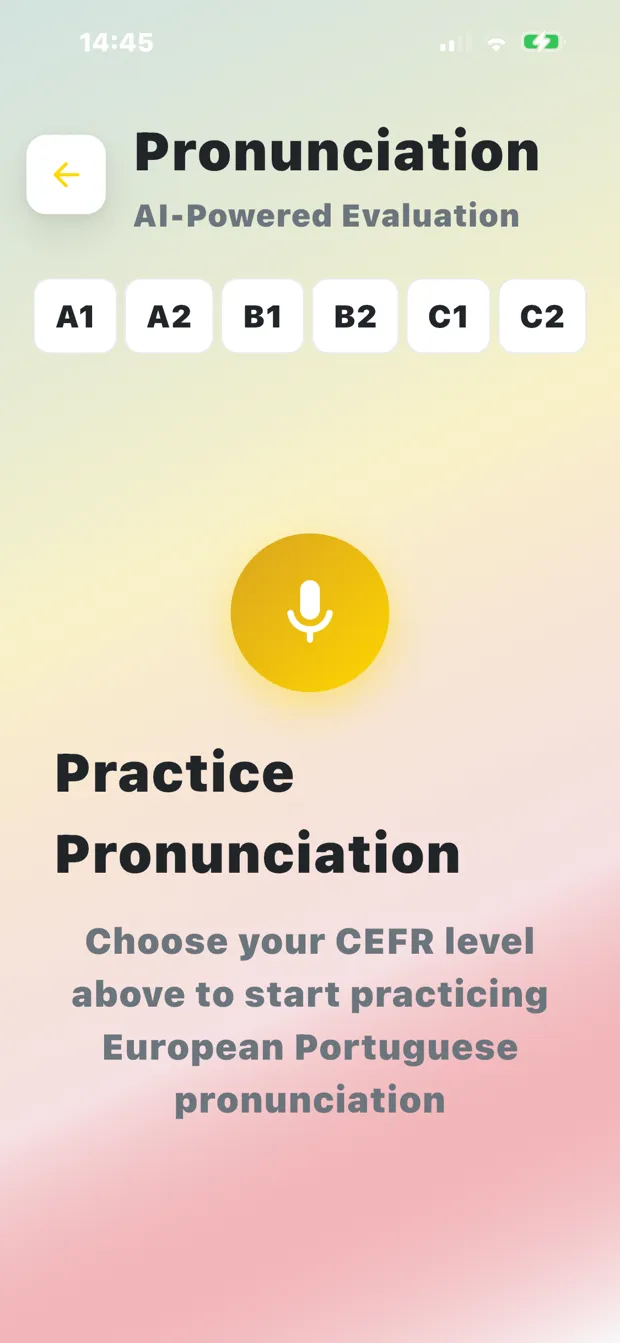
Train the sounds Japanese doesn't have
Portugal Lifestyle Pro teaches European Portuguese with native Lisbon and Porto audio and an AI pronunciation test with voice feedback, which is exactly what the l, r and rr contrast needs. Full CEFR levels A1 to C2, plus the tu and o senhor register distinctions Portugal actually uses.
Download Free on the App Store Google Play Web App
Free download · 7-day free trial · 500+ lessons · Native Lisbon audio
On the App Store as Learn European Portuguese Pro
What should we build next?
This guide exists because someone asked for it. If there's a topic, lesson type or feature you want in Portugal Lifestyle Pro, tell us — it's five questions and takes about two minutes.
Share your ideas & feedback → No account needed · Email optional · We read every answer