Moving to Portugal with Family: What to Plan and When
Moving to Portugal alone is an admin exercise. Moving with children is a sequencing problem: school places, residency appointments, housing and healthcare registration all depend on each other, and getting the order wrong costs months.
Here's the sequence that works, and where families most often get stuck.
A realistic timeline
| When | What to do |
|---|---|
| 12 months out | Choose a region. Shortlist schools and check waiting lists for your children's exact year groups. |
| 9–12 months | Apply to schools. Get NIFs. Start the whole family on Portuguese. |
| 6–9 months | Apostille and translate birth certificates, marriage certificate and school records. Begin the visa application. |
| 3–6 months | Secure the school place. Arrange rental near it. Book flights and shipping. |
| Arrival | AIMA appointment, register with the local health centre, enrol children, open a bank account. |
| First year | Settle in, build community, keep the language going. Residency renewals as required. |
The single most common mistake: signing a rental contract before securing a school place. Schools have catchment areas and waiting lists — let the school decide the neighbourhood, not the other way round.
Visas and bringing your family
Most families arrive on one of the standard routes — the D7 (passive income), the D8 (digital nomad), or a work visa. Spouses and dependent children are generally included through family reunification (reagrupamento familiar), so you usually don't need separate independent visas for each family member.
You'll need apostilled and translated marriage and birth certificates to prove the relationships. Requirements and processing times change, and Portuguese nationality law was amended in 2026 — confirm current rules with AIMA or an immigration lawyer rather than relying on any general guide, including this one. Our visa guide covers the routes in more detail.
Choosing schools
This usually drives everything else. The short framework:
- Children under 10, staying long term: state school works well and is free. They'll be fluent within a year.
- Children 12+, or a stay of only a few years: an international school avoids a brutal mid-education language switch, at €8,000–28,000 per child per year.
- The middle path: a Portuguese colégio — bilingual private school at roughly €3,000–8,000 — which most families never consider.
Full detail in our guide to schools in Portugal.
Healthcare for the family
Once you're a legal resident, you register at your local centro de saúde (health centre) and are assigned a family doctor. State healthcare (the SNS) is low-cost, with small fees for appointments. Waiting times for non-urgent specialist care can be long, which is why many expat families also carry private insurance — typically far cheaper than US equivalents.
Bring full vaccination records. Portugal follows its own Plano Nacional de Vacinação, which differs in places from UK and US schedules, and schools will ask for the history.
Housing
Rent first. Almost everyone who buys immediately regrets something — the area, the winter damp, the commute to school. A year's rental tells you what you actually need.
Practical notes: Portuguese homes are often poorly insulated and unheated, and winter indoor temperatures surprise people from colder countries with better-built housing. Check for damp, double glazing and a real heating source. Landlords typically ask for two to three months upfront plus proof of income, and you'll need a NIF to sign anything.
The part families underestimate: language
Children in Portuguese schools become fluent whether you plan for it or not. Parents are the ones who struggle — and it shows up in specific, isolating ways:
- School WhatsApp groups run entirely in Portuguese
- Parent-teacher meetings are in Portuguese
- The health centre, the town hall and tradespeople default to Portuguese
- Your children start translating for you, which flips a dynamic most parents dislike
Families who handle this well start before arrival, and treat it as a household activity rather than a parental chore. Learning together — even 15 minutes a day — works far better than one parent studying alone. Remember it's European Portuguese you need, not Brazilian, which is what most apps teach.
Building a community
The school gate is the fastest route in, but only if you can hold a conversation there. Beyond that: local sports clubs, municipal pools and juntas de freguesia (parish councils) run activities that mix you with actual neighbours rather than only other foreigners.
A word of caution about expat bubbles, particularly in the central Algarve: they make the first six months easy and the next five years insular. The families who report being happiest a few years in are almost always the ones who made Portuguese friends, which almost always required Portuguese.
Frequently asked questions
Can I bring my children when I move to Portugal?
Yes. Spouses and dependent children are generally included through family reunification, known as reagrupamento familiar, rather than needing separate independent visas. You will need apostilled and translated birth and marriage certificates to prove the relationships.
Is Portugal a good place to raise children?
Portugal consistently ranks among the safest countries in the world, healthcare is accessible and low cost, and family life is culturally central, with children genuinely welcome in restaurants and public life. The main challenges are lower salaries than northern Europe and the language transition for older children.
What should I do first when moving to Portugal with kids?
Choose the region, then secure school places before renting a home. Schools have catchment areas and waiting lists, so the school should determine the neighbourhood rather than the reverse. Get NIF numbers and start apostilling documents early, as these steps are slow.
Do my children need to speak Portuguese before moving?
It is not required, and children under 10 typically become conversational within 3 to 6 months in a Portuguese school. Starting beforehand reduces the initial stress considerably, and it matters far more for parents, who do not get the same immersion children receive at school.
How much does it cost to move a family to Portugal?
Beyond flights and shipping, budget for visa and legal fees, apostilles and certified translations for each family member, two to three months rent upfront, and school fees if choosing private or international education, which run from about 3,000 to 28,000 euros per child per year.
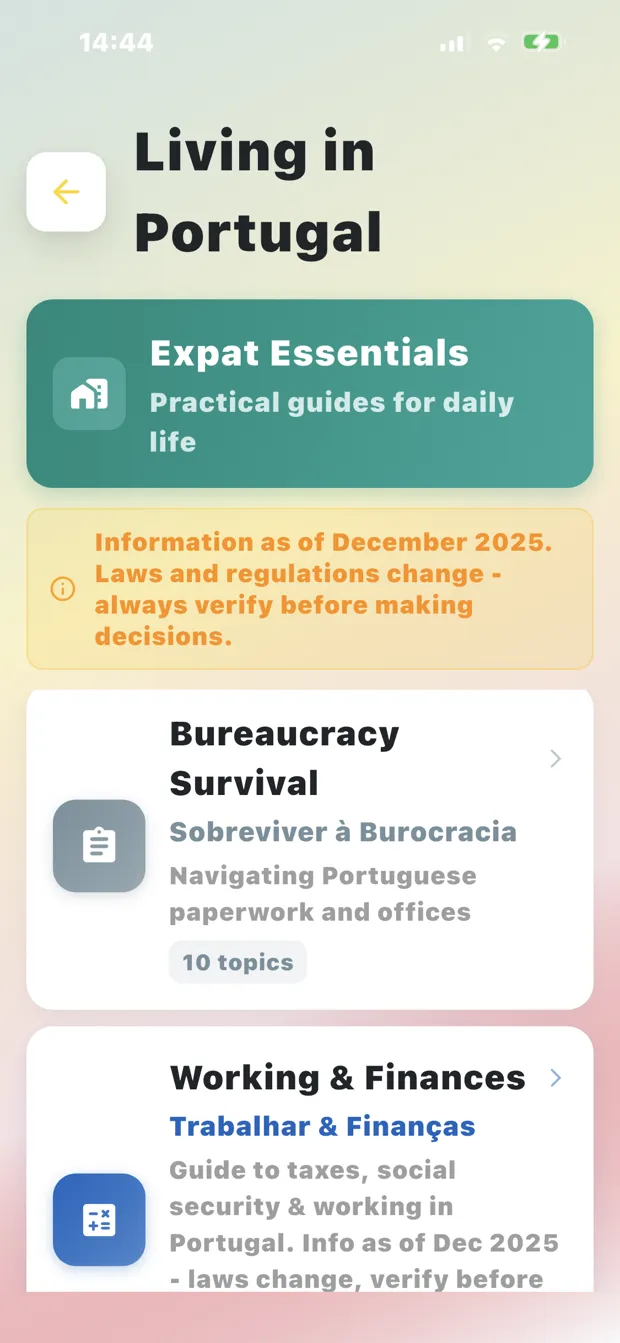
Learn the language that goes with it
Your children will pick up Portuguese at school. You won't, unless you plan for it. Portugal Lifestyle Pro is built for exactly this: European Portuguese with native Lisbon audio, structured CEFR levels, and games that make it something the whole family can do together.
Download Free on the App Store Google Play Web App
Free download · 7-day free trial · 500+ lessons · Native Lisbon audio
On the App Store as Learn European Portuguese Pro
What should we build next?
This guide exists because someone asked for it. If there's a topic, lesson type or feature you want in Portugal Lifestyle Pro, tell us — it's five questions and takes about two minutes.
Share your ideas & feedback → No account needed · Email optional · We read every answer