Schools in Portugal: A Guide for Expat Parents
Portuguese state schools are free to all legal residents, including foreign children, and the quality is generally solid. The real decision for most expat families isn't cost — it's language, and how old your child is when you arrive.
The short version: under about 10, children usually absorb Portuguese within 6–12 months and integrate well. From roughly 12 upwards, dropping into a Portuguese-language classroom is genuinely hard, and that's when families start looking at international schools.
How the system is structured
| Level | Age | Portuguese name |
|---|---|---|
| Pre-school (optional) | 3–5 | Pré-escolar |
| Primary | 6–9 (1st–4th year) | 1º Ciclo do Ensino Básico |
| Middle | 10–11 (5th–6th) | 2º Ciclo do Ensino Básico |
| Lower secondary | 12–14 (7th–9th) | 3º Ciclo do Ensino Básico |
| Upper secondary | 15–17 (10th–12th) | Ensino Secundário |
| University | 18+ | Ensino Superior |
Education is compulsory from 6 to 18. The academic year runs from mid-September to late June. Grading is on a 1–5 scale in primary, switching to 0–20 from the 5th year onward — where 10 is a pass and anything above 16 is genuinely strong.
The three options
| Type | Cost per year | Language | Best for |
|---|---|---|---|
| Public (state) | Free | Portuguese | Long-term families wanting full integration |
| Portuguese private (colégio) | ~€3,000–8,000 | Portuguese with strong English | Integration with smaller classes |
| International | ~€8,000–28,000 | English (or German, French) | Older children, shorter stays, curriculum continuity |
The middle option — a Portuguese colégio — is the one most expat families overlook. They're bilingual, considerably cheaper than international schools, and still deliver real Portuguese integration.
Enrolling in a state school
You enrol through the Agrupamento de Escolas (school cluster) covering your address. Children are assigned to a school in their catchment area, so where you rent determines where they study.
Bring:
- Proof of address (a rental contract or utility bill)
- The child's birth certificate — apostilled and translated into Portuguese
- Vaccination record
- Parent's NIF (tax number)
- Residency document
The apostille and certified translation catch people out constantly. Sort these in your home country before you leave — doing it retroactively from Portugal is slow and irritating. The same applies to any previous school records you'll need for placement.
The language reality
All classes in state schools are taught in Portuguese. Most schools offer Português Língua Não Materna support for non-native speakers, though quality varies a lot between schools — it's worth asking specifically what support exists before committing to an area.
Realistically:
- Ages 4–8: conversational within 3–6 months. This age group essentially absorbs the language.
- Ages 9–11: typically 6–12 months to function comfortably.
- Ages 12+: much harder. Academic Portuguese is a different challenge from playground Portuguese, and teenagers are simultaneously trying to make friends and sit exams.
Families who succeed here almost always start the language before arriving — and crucially, the parents learn too. Children in Portuguese schools pick it up regardless; parents who don't are the ones left out of school WhatsApp groups and parent meetings.
Practical details worth knowing
- Mid-year moves are possible but need approval from the school cluster director. Don't assume a September-only window.
- Vaccinations follow Portugal's Plano Nacional de Vacinação, which differs in places from UK and US schedules. Bring the full history.
- Meals: state schools provide subsidised hot lunches, typically only a couple of euros a day.
- Books: free or heavily subsidised in state schools for compulsory years.
- School day is generally longer than the UK norm, often with an extended-hours option covering working parents.
Homeschooling
Legal, but heavily regulated and rare in practice. You must register with the Direção-Geral de Educação, children sit national exams at the end of each cycle, one parent must hold a university degree or equivalent, and there's annual reporting. Some families use UK or US accredited online schools instead, though the legal standing of that in Portugal is not clearly settled — take advice before relying on it.
University, briefly
Public university fees are legally capped and remarkably low for EU students, around €700–1,100 a year. Non-EU students typically pay €3,500–7,000. The University of Coimbra, founded in 1290, is one of the oldest in Europe, and Lisbon, Porto and NOVA all rank well. There's a growing number of degrees taught fully in English. Non-EU students need a D4 student visa.
Frequently asked questions
Are schools free in Portugal for foreigners?
Yes. State schools are free for all legal residents, including foreign children. Books and materials are free or heavily subsidised in compulsory years, and school lunches are subsidised to a couple of euros a day.
How quickly do children learn Portuguese in a Portuguese school?
Children aged 4 to 8 typically become conversational within 3 to 6 months. Children aged 9 to 11 usually need 6 to 12 months. Teenagers from about 12 upwards find it considerably harder, because academic Portuguese is a much bigger step than playground Portuguese.
What documents do I need to enrol my child in a Portuguese school?
Proof of address, the child's birth certificate apostilled and translated into Portuguese, a vaccination record, the parent's NIF tax number, and your residency document. Arrange the apostille and certified translation before leaving your home country, as doing it from Portugal is slow.
Should my child go to a Portuguese state school or an international school?
It largely depends on age and how long you plan to stay. Under about 10, state school integration usually works very well and is free. From 12 upwards, or for stays of only a few years, an international school offers curriculum continuity and avoids a difficult language transition mid-education.
What is a colégio in Portugal?
A colégio is a Portuguese private school, sitting between state schools and international schools. They teach mainly in Portuguese with strong English instruction, typically cost around 3,000 to 8,000 euros a year, and suit families who want integration with smaller class sizes.
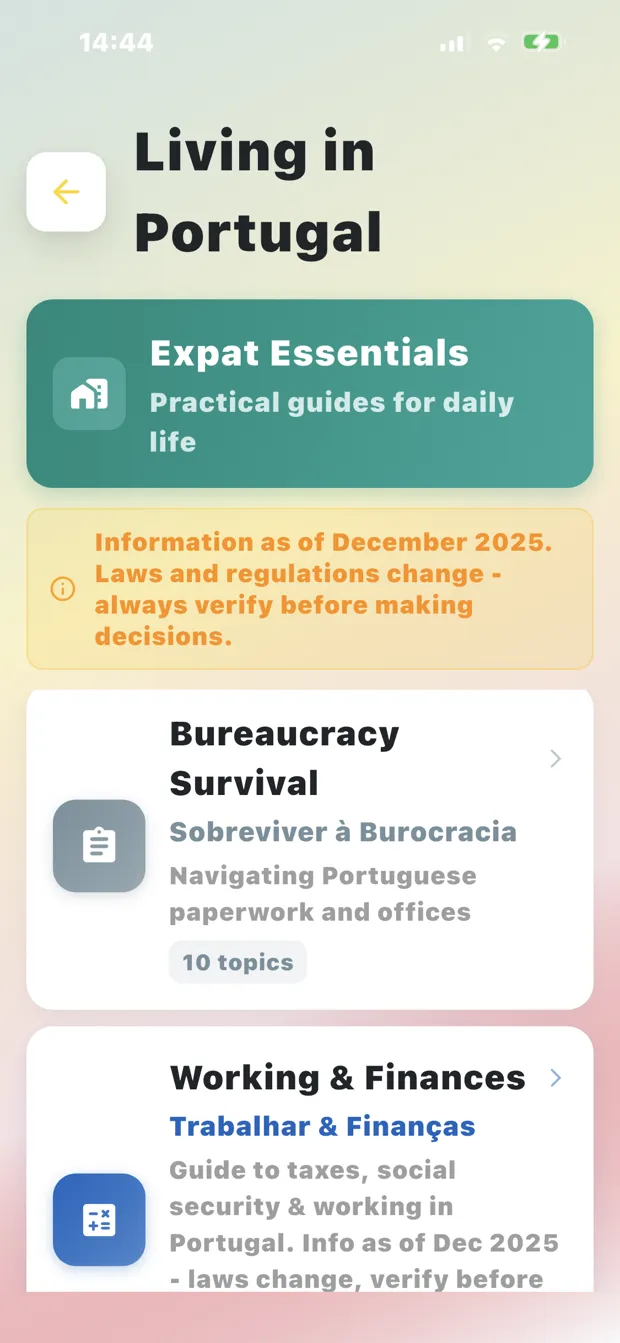
Learn the language that goes with it
Children in Portuguese schools pick the language up fast. Parents are the ones who get left behind at the school gate. Portugal Lifestyle Pro teaches European Portuguese with native Lisbon audio, so the whole family can keep up with teachers, parent meetings and school WhatsApp groups.
Download Free on the App Store Google Play Web App
Free download · 7-day free trial · 500+ lessons · Native Lisbon audio
On the App Store as Learn European Portuguese Pro
What should we build next?
This guide exists because someone asked for it. If there's a topic, lesson type or feature you want in Portugal Lifestyle Pro, tell us — it's five questions and takes about two minutes.
Share your ideas & feedback → No account needed · Email optional · We read every answer