Portuguese Grammar by CEFR Level: A1 to C2
Most Portuguese courses teach grammar in whatever order suits the textbook. The CEFR framework does something more useful: it maps each structure to the level where you actually need it. This page lays out what belongs where, for European Portuguese specifically.
It matters practically. A2 is the level required for Portuguese citizenship via the CIPLE exam, so knowing exactly which grammar sits inside A1 and A2 tells you precisely where the finish line is.
Quick reference: the whole ladder
| Level | Core grammar | Typical time |
|---|---|---|
| A1 | Present tense, gender and articles, ser vs estar, estar a + infinitive, ir + infinitive | 1–2 months |
| A2 | Two past tenses, object pronouns and their placement, reflexives, imperative, comparatives | 4–6 months |
| B1 | Present and future subjunctive, personal infinitive, relative pronouns, reported speech | 10–14 months |
| B2 | Imperfect subjunctive, full conditionals, passive voice, register control | 2 years+ |
| C1 | Pluperfect subjunctive, complex subordination, idiom, stylistic nuance | 3 years+ |
| C2 | Near-native command across all registers | Sustained immersion |
A1 — the foundations
| Structure | Example |
|---|---|
| Noun gender and plurals | o livro, a casa, os livros |
| Definite and indefinite articles | o, a, os, as / um, uma, uns, umas |
| Subject pronouns (including tu) | eu, tu, ele/ela, nós, vocês, eles/elas |
| Present indicative, regular | falar → falo, comer → como, partir → parto |
| Core irregular verbs | ser, estar, ter, ir, fazer, poder, querer |
| Ser vs estar | Sou português / Estou cansado |
| Adjective agreement | o carro branco, a casa branca |
| Possessives | o meu carro, a minha casa |
| Demonstratives | este, esse, aquele |
| Preposition contractions | em + o = no, de + a = da, a + o = ao |
| Present continuous (EP form) | estou a falar — not estou falando |
| Near future | vou comer |
| Negation and question words | não; quem, o quê, onde, quando, como, quanto |
Two things here already separate Portugal from Brazil: the tu conjugations, which Brazilian-focused courses barely teach, and estar a + infinitive where Brazil uses the gerund. See the A1 guide.
A2 — the citizenship level
This is the level the CIPLE exam tests. Everything below is inside scope.
| Structure | Example |
|---|---|
| Pretérito perfeito simples (completed past) | falei, comi, fui |
| Pretérito imperfeito (habitual / descriptive past) | falava, comia, era |
| Choosing between the two past tenses | Ontem falei com ele / Antigamente falava todos os dias |
| Direct object pronouns | o, a, os, as — Vi-o ontem |
| Indirect object pronouns | me, te, lhe, nos, lhes — Deu-me o livro |
| Pronoun placement (enclisis vs proclisis) | Ele deu-me (PT) vs Ele me deu (BR) |
| Reflexive verbs | chamar-se, levantar-se, sentir-se |
| Imperative, affirmative and negative | Fala! / Não fales! |
| Comparatives and superlatives | mais alto do que, o mais alto |
| Conditional (basic) | gostaria, queria |
| Adverb formation | rápido → rapidamente |
Pronoun placement is the single biggest A2 hurdle for anyone who learned Brazilian Portuguese. Portugal attaches pronouns to the end of the verb by default; Brazil puts them before. Getting this wrong marks you instantly, and it appears throughout the CIPLE exam. See the A2 guide.
B1 — where the subjunctive arrives
| Structure | Example |
|---|---|
| Present subjunctive | Espero que ele venha |
| Future subjunctive — heavily used in Portuguese | Quando eu for a Lisboa…, Se tiveres tempo… |
| Personal infinitive — distinctive to Portuguese | É melhor tu ires, antes de nós sairmos |
| Compound pluperfect | tinha falado |
| Relative pronouns | que, quem, onde, cujo |
| Reported speech | Ele disse que ia sair |
| Conditional sentences (types 1 and 2) | Se tiver tempo, vou / Se tivesse tempo, ia |
| Future simple | falarei — formal; vou falar dominates speech |
Two structures here barely exist in other Romance languages. The future subjunctive is largely fossilised in Spanish but fully alive in Portuguese — you cannot say "when I go" correctly without it. And the personal infinitive, an infinitive that conjugates for person, is essentially unique to Portuguese. See the B1 guide.
B2 — controlling the moods
| Structure | Example |
|---|---|
| Imperfect subjunctive | Se eu fosse rico… |
| Perfect subjunctive | Espero que tenha corrido bem |
| Conditional perfect | Teria falado |
| All conditional types, including counterfactuals | Se tivesse sabido, teria ido |
| Passive voice, and ser vs estar passives | foi construído vs está construído |
| Complex relative and concessive clauses | embora, ainda que, apesar de |
| Discourse markers | aliás, contudo, portanto, ou seja |
| Register control | tu / você / o senhor used deliberately |
C1 and C2 — nuance and range
| Level | What is added |
|---|---|
| C1 | Pluperfect subjunctive (tivesse falado), future perfect, dense subordination, idiomatic and colloquial range, mood selection where either is grammatical but one is better, comfort with regional accents and slang |
| C2 | Near-native command: literary and archaic forms, precise stylistic control, humour and irony, effortless register switching, fluent comprehension of fast regional speech |
Realistically, C1 and C2 are reached through sustained immersion rather than study alone. Very few learners need them — A2 satisfies citizenship, and B1 to B2 covers professional life comfortably.
The structures unique to European Portuguese
If you are learning from materials built for Brazil, these are the gaps you will have, regardless of your level:
| Feature | Portugal | Brazil | Level |
|---|---|---|---|
| Continuous aspect | estou a falar | estou falando | A1 |
| Second person singular | tu falas — everyday | você fala dominates | A1 |
| Pronoun position | deu-me (enclisis) | me deu (proclisis) | A2 |
| Future subjunctive | Fully active | Active but less frequent | B1 |
| Personal infinitive | Common in speech | Less frequent | B1 |
Full comparison in European vs Brazilian Portuguese.
How to actually work through it
Do not study grammar as a separate subject. The order above works because each level's structures are the ones you need to say what you want to say at that stage. Learn them when you hit the wall that requires them.
A practical sequence: get the A1 present tense automatic before touching past tenses. Get both past tenses solid before the subjunctive. And drill pronoun placement early, because retrofitting it later is genuinely painful. Our learning roadmap sets out the wider plan, and the verb conjugation guide covers the tables in detail.
Frequently asked questions
What grammar do I need for A2 Portuguese?
A2 covers the two main past tenses, the preterito perfeito simples and the imperfeito, direct and indirect object pronouns and their placement, reflexive verbs, the imperative, comparatives and superlatives, and the basic conditional. A2 is the level required for Portuguese citizenship through the CIPLE exam.
At what CEFR level does the Portuguese subjunctive start?
The present subjunctive and the future subjunctive are both introduced at B1. The imperfect subjunctive follows at B2, and the pluperfect subjunctive at C1. The future subjunctive is particularly important in Portuguese, since it is needed for common sentences such as quando eu for.
What level of Portuguese do I need for citizenship?
A2, normally proven through the CIPLE exam. That means present tense, both main past tenses, object pronouns with correct placement, reflexives, the imperative and comparatives. It does not require the subjunctive, which begins at B1.
What is the personal infinitive in Portuguese?
The personal infinitive is an infinitive that conjugates for person, as in e melhor tu ires or antes de nos sairmos. It is essentially unique to Portuguese among major Romance languages and is introduced at B1 level.
How long does it take to reach each CEFR level in Portuguese?
With 20 to 30 minutes of daily study, A1 typically takes 1 to 2 months, A2 around 4 to 6 months, and B1 roughly 10 to 14 months. B2 usually takes over two years, and C1 and C2 generally require sustained immersion rather than study alone.
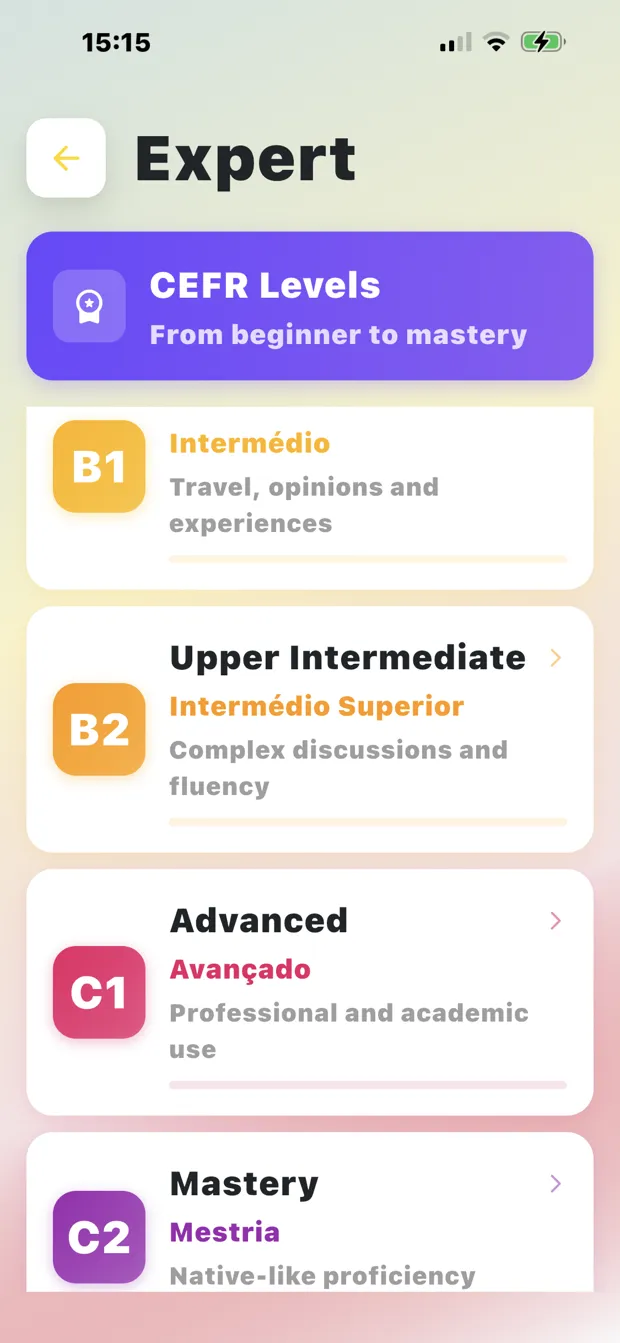
Grammar organised by CEFR level, not by textbook chapter
Portugal Lifestyle Pro follows the CEFR framework from A1 to C2, so every lesson sits at a defined level and you always know how far you are from A2 and citizenship. All European Portuguese, with native Lisbon and Porto audio, plus conjugation drills and games at each level.
Download Free on the App Store Google Play Web App
Free download · 7-day free trial · 500+ lessons · Native Lisbon audio
On the App Store as Learn European Portuguese Pro
What should we build next?
This guide exists because someone asked for it. If there's a topic, lesson type or feature you want in Portugal Lifestyle Pro, tell us — it's five questions and takes about two minutes.
Share your ideas & feedback → No account needed · Email optional · We read every answer