How to Learn European Portuguese: A Practical Roadmap
Most Portuguese resources teach Brazilian Portuguese. If your destination is Portugal, that's a problem: the pronunciation, the grammar you'll hear on the street and even everyday words are different. This is a complete roadmap for European Portuguese specifically — the order to learn things in, how long each stage takes, and the mistakes that cost people months.
In short: train your ear on Portugal-recorded audio from day one, learn survival phrases before grammar, build vocabulary with spaced repetition, drill the five core verbs, and start speaking long before you feel ready. At 15–30 minutes a day, that path reaches conversational A2 in roughly 4–6 months.
Step 1: Train your ear first
European Portuguese "swallows" unstressed vowels — obrigado sounds closer to "obrigad", and está often lands as "tá". If you learn from text alone, real speech will feel impossibly fast. From day one, learn every word with native audio recorded in Portugal, not Brazil.
Listening is the single biggest hurdle for learners in Portugal, so front-load it. Practical routine: 10 minutes of Portugal-recorded audio daily, even passively, before you worry about grammar tables. Our listening practice guide covers how to build this habit, and the EP vs BR comparison explains exactly which sounds differ.
Step 2: Learn survival phrases before grammar
Your first 100 phrases matter more than your first grammar rule. Ordering a coffee (um café, por favor), greeting neighbours (bom dia), asking prices (quanto custa?) — these give you daily wins and force correct pronunciation early.
The psychology matters here: successfully ordering something in Portuguese in week one does more for your motivation than any amount of theory. Start with our essential travel phrases, then move to the beginner's guide.
Step 3: Build vocabulary with spaced repetition
Aim for roughly 1,000 words to hold basic conversations, and about 3,000 to feel comfortable. Flashcards with audio and spaced repetition are the most efficient route — 10 minutes a day beats a 2-hour weekend binge, because spacing is what moves words into long-term memory.
Two rules that make a real difference: always learn a word with its audio, and always learn nouns with their article (o comboio, a casa) so gender sticks automatically. See the flashcards guide and vocabulary builder.
Step 4: Tackle verbs deliberately
Portuguese verbs carry the sentence. Master these five in the present tense first — they cover an enormous share of everyday speech:
- ser — to be (permanent): eu sou, tu és, ele é
- estar — to be (temporary): eu estou, tu estás, ele está
- ter — to have: eu tenho, tu tens, ele tem
- ir — to go: eu vou, tu vais, ele vai
- fazer — to do/make: eu faço, tu fazes, ele faz
Note the tu forms — Brazilian courses often skip these, but you'll hear them constantly in Portugal. Once the present tense is automatic, add the pretérito perfeito (past), then the future. Full tables in the verb conjugation guide.
Step 5: Speak before you feel ready
The gap between understanding and speaking only closes through speaking. Practice out loud daily — with a partner, a tutor, or an AI conversation partner that lets you rehearse the café or the pharmacy with zero embarrassment.
Most learners wait far too long here, then discover that a year of silent study produced no speaking ability at all. Start at week two, even if it's just reading sentences aloud. See conversation practice.
How long does it take?
With 15–30 focused minutes daily, here's a realistic timeline:
| Level | Time (daily practice) | What you can do |
|---|---|---|
| A1 | 1–2 months | Greetings, ordering, basic questions, numbers |
| A2 | 4–6 months | Everyday conversations, appointments, shopping — the CIPLE citizenship level |
| B1 | 10–14 months | Opinions, past and future, handling the unexpected |
| B2 | 2 years+ | Work meetings, complex discussion, most media |
Consistency is everything: streaks beat marathons. Twenty minutes every day genuinely outperforms three hours every Sunday, because spaced repetition only works if the spacing happens.
Five mistakes that cost learners months
- Learning the wrong variant. A year on a Brazilian-only app leaves you unable to follow a Lisbon conversation. Fix it on day one, not month twelve.
- Reading without listening. Written Portuguese hides all the vowel reduction. If you can read but not hear, you've built half a skill.
- Waiting until you're "ready" to speak. You won't feel ready. Speak badly early instead.
- Grammar-first study. Rules make sense once you've heard the patterns. Front-loading conjugation tables kills motivation before you get any real-world win.
- Ignoring tu forms. Portugal uses tu constantly. Courses built for Brazil barely cover it, which leaves a hole you'll hit in every casual conversation — and in the CIPLE exam.
A realistic weekly routine
If you want something concrete to follow, this works and takes about 25 minutes a day:
- 10 min — flashcards with native audio (vocabulary, spaced repetition)
- 10 min — a structured lesson or verb drill at your CEFR level
- 5 min — speaking out loud: repeat phrases, or hold a short conversation
- Passive bonus — Portuguese radio, podcasts or TV in the background while cooking or commuting
Want to make the practice feel less like study? Our free Portuguese games include 100 levels of word search, word matching, sentence building and numbers — no sign-up needed.
Frequently asked questions
Can I learn European Portuguese on my own?
Yes. Self-study with a structured app, native audio and daily speaking practice gets most people to A2 comfortably. A tutor accelerates the speaking stage, but isn't required to reach conversational level.
Is European Portuguese hard for English speakers?
The grammar is moderately difficult (gendered nouns, many verb tenses, the subjunctive), but listening is the real challenge because of vowel reduction. The US Foreign Service Institute classes Portuguese as a Category I language — among the more achievable for English speakers, at roughly 600–750 hours to professional working proficiency.
What level do I need for Portuguese citizenship?
A2, normally proven through the CIPLE exam. Most learners reach it in 4–6 months of consistent daily study. See the CIPLE preparation guide.
Should I learn grammar or vocabulary first?
Vocabulary and set phrases first. You can communicate a great deal with words and no grammar; grammar with no words gets you nowhere. Layer grammar in from about month two, once the patterns already sound familiar.
Do it with Portugal Lifestyle Pro
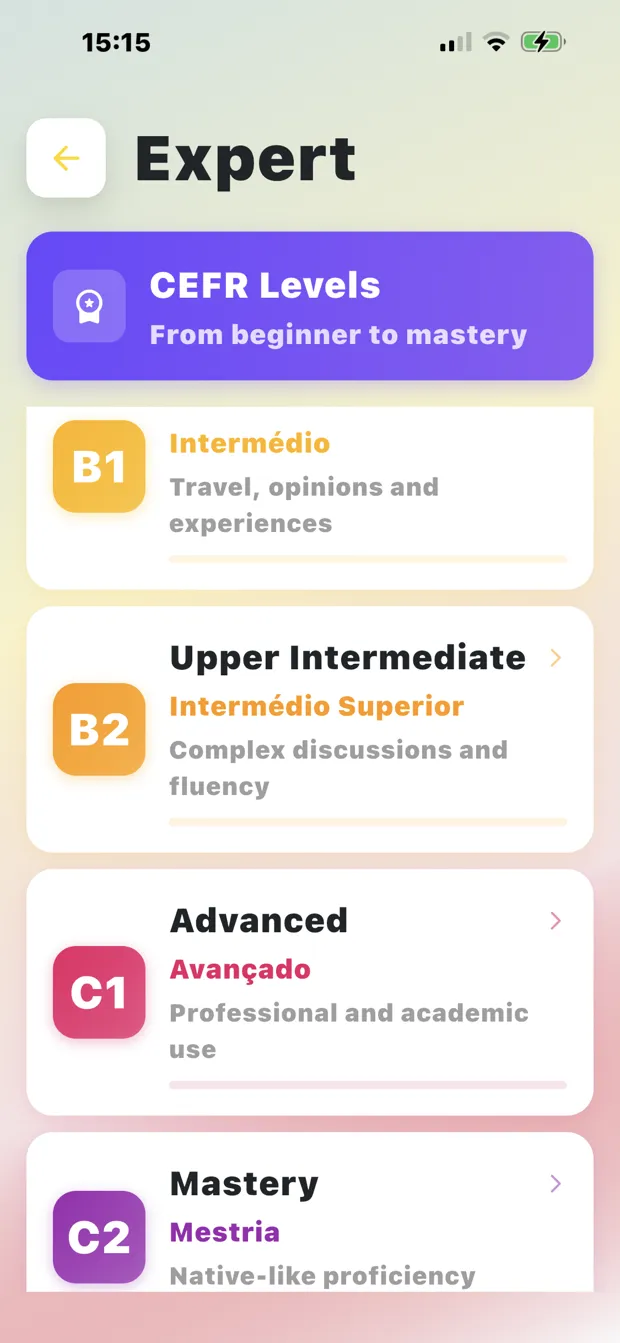
Portugal Lifestyle Pro was built around exactly this roadmap. Start the A1 module in Campus for phrases with native Lisbon audio, drill vocabulary with the built-in flashcards, run daily verb conjugation challenges, then rehearse real conversations with Amigo AI. The CEFR structure (A1–C2) means you always know exactly what to learn next.
Download Free on the App Store Google Play Web App
Free download · 7-day free trial · 500+ lessons · Native Lisbon audio
On the App Store as Learn European Portuguese Pro
What should we build next?
This guide exists because someone asked for it. If there's a topic, lesson type or feature you want in Portugal Lifestyle Pro, tell us — it's five questions and takes about two minutes.
Share your ideas & feedback → No account needed · Email optional · We read every answer