C1 and C2 Portuguese: What Mastery Actually Looks Like
C1 and C2 are the top of the CEFR framework, and they work differently from everything below. Up to B2, progress comes largely from study. Beyond it, progress comes from living in the language — reading widely, arguing, joking, being corrected by people who know you well enough to bother.
Very few learners need these levels, and that is worth saying plainly before you set them as a goal.
C1 — advanced
At C1 you operate without obvious limitation. You follow long, complex speech even when it is poorly structured, read demanding texts, and express yourself fluently without visibly searching for words. You use the language flexibly for social, academic and professional purposes.
| What is added at C1 | Example |
|---|---|
| Pluperfect subjunctive | Se tivesse falado com ele antes… |
| Future perfect | Terá terminado até sexta |
| Dense subordination | Multiple embedded clauses held together correctly |
| Mood selection by nuance | Where both indicative and subjunctive are grammatical, but one is better |
| Idiom and colloquialism | estar com os azeites, ficar a ver navios |
| Regional comprehension | Northern, Alentejano and Azorean speech at natural speed |
C2 — mastery
C2 is not "perfect Portuguese" and it is not the same as being a native speaker. It means you understand virtually everything you hear or read, summarise complex material coherently, and express yourself precisely and spontaneously with fine shades of meaning.
- Literary and older written forms, including tenses rare in speech
- Precise stylistic control — the same idea delivered formally, warmly or bluntly at will
- Humour, irony and wordplay, both understood and produced
- Effortless register switching between a café and a courtroom
- Comprehension of fast, overlapping, dialect-heavy conversation
Who actually needs C1 or C2
| Situation | Level typically expected |
|---|---|
| Portuguese citizenship | A2 |
| Comfortable daily life | B1 |
| Most professional work in Portuguese | B2 |
| Regulated professions — medicine, law, teaching | Often C1 |
| Academic work, translation, interpreting | C1 to C2 |
| Literary or editorial work in Portuguese | C2 |
If you are learning Portuguese to live in Portugal, B1 or B2 is almost certainly your real target. Chasing C-level as a general aspiration tends to produce frustration rather than fluency.
How you actually get there
Structured courses thin out above B2, because at that point the remaining gains are in exposure and precision rather than new rules. What works:
- Read at volume. Portuguese authors, Portuguese journalism, not translations. Saramago, Eça de Queirós, Lídia Jorge — and the daily papers.
- Consume unadapted audio. Radio phone-ins, podcasts, live television. Fast, unscripted, overlapping speech is the last comprehension barrier.
- Write and get corrected. Nobody corrects your speech at this level, so written feedback becomes the main mechanism.
- Live in it. The single strongest predictor is whether your daily life genuinely runs in Portuguese, or whether you switch to English whenever it gets hard.
There are formal exams at these levels through the same CAPLE system that runs the CIPLE A2 exam — DAPLE at C1 and DUPLE at C2 — which matter if you need certification for a profession or a university.
If you are earlier in the journey, the practical route is in our learning roadmap and the grammar by CEFR level reference.
Frequently asked questions
What is C1 Portuguese?
C1 is advanced. You follow long and complex speech even when poorly structured, read demanding texts, and express yourself fluently without visibly searching for words. Grammar additions include the pluperfect subjunctive, the future perfect and nuanced mood selection.
What is the difference between C1 and C2 Portuguese?
C1 means operating without obvious limitation across social, academic and professional contexts. C2 adds precision and range: literary and older forms, fine stylistic control, humour and irony, effortless register switching, and comprehension of fast dialect-heavy speech.
Do I need C1 or C2 Portuguese to live in Portugal?
No. Citizenship requires A2, daily life is comfortable at B1, and most professional work is manageable at B2. C1 is typically expected for regulated professions such as medicine, law and teaching, and C1 to C2 for academic work, translation and interpreting.
Are there Portuguese exams at C1 and C2 level?
Yes. The same CAPLE system that runs the CIPLE exam at A2 offers DAPLE at C1 and DUPLE at C2. These matter mainly if you need formal certification for a profession or a university place.
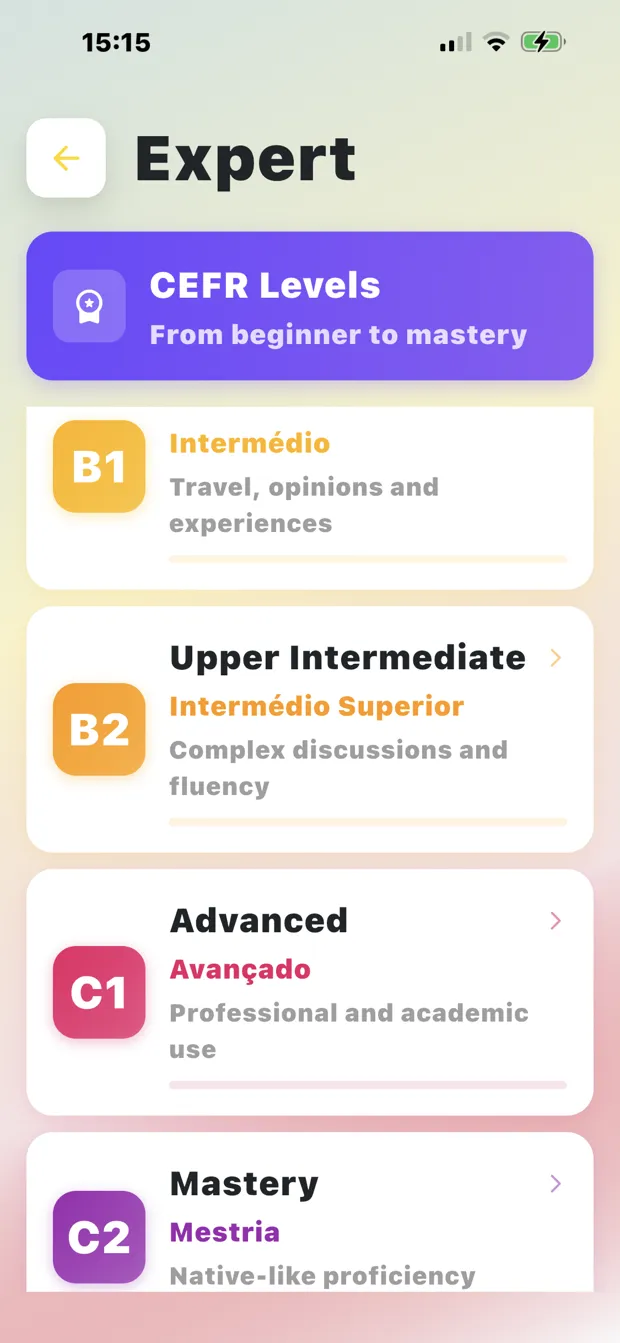
The full range, A1 to C2
Portugal Lifestyle Pro covers every CEFR level from A1 to C2 in European Portuguese, with native Lisbon and Porto audio. Lessons, games and pronunciation practice are graded by level, so advanced material is there when you are ready for it.
Download Free on the App Store Google Play Web App
Free download · 7-day free trial · 500+ lessons · Native Lisbon audio
On the App Store as Learn European Portuguese Pro
What should we build next?
This guide exists because someone asked for it. If there's a topic, lesson type or feature you want in Portugal Lifestyle Pro, tell us — it's five questions and takes about two minutes.
Share your ideas & feedback → No account needed · Email optional · We read every answer