B2 Portuguese: Upper Intermediate, and What It Unlocks
B2 is where Portuguese stops being a project and starts being a language you live in. You can hold your own in a work meeting, follow a film without subtitles most of the time, and argue a point rather than just state one.
It is also the level that starts unlocking things: many Portuguese universities require around B2 for degree programmes taught in Portuguese, and several regulated professions expect B2 or higher before you can practise.
What you can do at B2
- Follow extended speech and most television, including news and interviews
- Take part in a meeting or a debate, and defend a position
- Write clear, structured text — a report, a formal complaint, a detailed email
- Read newspapers and general non-fiction comfortably
- Interact with native speakers fluently enough that neither side is straining
- Understand most accents, though fast regional speech may still catch you
The grammar that defines B2
| Structure | Example |
|---|---|
| Imperfect subjunctive | Se eu fosse rico, comprava uma casa no Algarve |
| Perfect subjunctive | Espero que tenha corrido bem |
| Conditional perfect | Teria ido, mas estava a trabalhar |
| Full counterfactual conditionals | Se tivesse sabido, teria avisado |
| Passive voice, and the ser / estar distinction in passives | foi construído vs está construído |
| Concessive clauses | embora, ainda que, apesar de |
| Discourse markers | aliás, contudo, portanto, ou seja, por outro lado |
| Deliberate register control | Choosing tu, você or o senhor for effect |
Full level-by-level breakdown in our grammar by CEFR level reference.
The real B1 to B2 jump
B1 to B2 is the longest gap in the whole framework, and it catches people out because progress stops feeling like progress. At A1 and A2 every week brings something you visibly could not do before. At B2 the gains are subtler: fewer hesitations, better word choice, understanding the joke rather than just the sentence.
Three things move the needle:
- Volume of input. This is the stage where consuming Portuguese media daily matters more than exercises. Podcasts, news, television — Portuguese-made, not dubbed.
- Producing longer output. Short exchanges plateau you. Write a few hundred words, or talk for several minutes uninterrupted.
- Correcting fossilised errors. By B1 most learners have habits that are wrong but comprehensible — often pronoun placement or ser and estar. Nobody corrects you because you are understood, so they set. Deliberate attention here is what separates B2 speakers from confident B1 ones.
How long it takes
Realistically two years or more of consistent study from zero, and typically a year beyond B1. That estimate assumes daily contact with the language; it stretches considerably if Portuguese is something you only touch at weekends.
The learners who reach B2 fastest are almost always those living in Portugal who deliberately chose Portuguese-speaking environments — a sports club, a job, a set of friends — rather than staying inside an English-speaking bubble.
Do you actually need B2?
Be honest about the goal. A2 is enough for citizenship via the CIPLE exam. B1 is comfortable for daily life. B2 is worth targeting if you want to study in Portuguese, work in a Portuguese-speaking company, enter a regulated profession, or simply stop feeling like a foreigner in conversation.
If none of those apply, going deep at B1 — really solid, fluent, confident B1 — serves most people better than a shaky B2.
Frequently asked questions
What does B2 Portuguese mean?
B2 is upper intermediate. You can follow extended speech and most television, take part in meetings and debates, write structured text such as reports and formal emails, and interact with native speakers fluently enough that neither side is straining.
What grammar is B2 in Portuguese?
B2 covers the imperfect subjunctive, the perfect subjunctive, the conditional perfect, full counterfactual conditionals, the passive voice including the ser and estar distinction, concessive clauses such as embora and apesar de, and deliberate register control.
How long does it take to reach B2 Portuguese?
Typically two years or more of consistent study from zero, and around a year beyond B1. That assumes daily contact with the language. B1 to B2 is the longest gap in the CEFR framework and progress feels slower because the gains are subtler.
Do I need B2 Portuguese for citizenship?
No. Portuguese citizenship requires A2, normally proven through the CIPLE exam. B2 is relevant for studying at a Portuguese university in Portuguese, working in a Portuguese-speaking company, or entering a regulated profession.
Keep going past the plateau
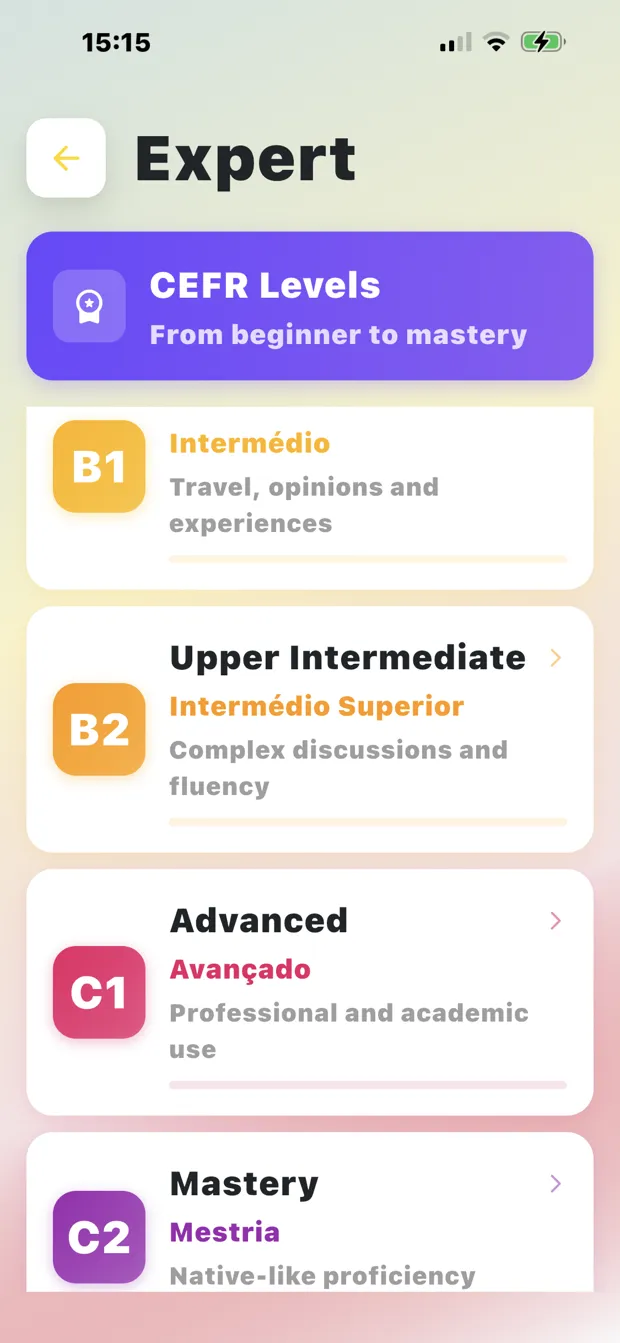
B1 to B2 is where most learners stall, because the wins stop being obvious. Portugal Lifestyle Pro covers the full CEFR range to C2 in European Portuguese, with native Lisbon and Porto audio, conjugation drills and AI conversation practice for the longer output B2 demands.
Download Free on the App Store Google Play Web App
Free download · 7-day free trial · 500+ lessons · Native Lisbon audio
On the App Store as Learn European Portuguese Pro
What should we build next?
This guide exists because someone asked for it. If there's a topic, lesson type or feature you want in Portugal Lifestyle Pro, tell us — it's five questions and takes about two minutes.
Share your ideas & feedback → No account needed · Email optional · We read every answer