The Advantages of Learning Portuguese
Portuguese rarely makes anyone's shortlist. People reach for Spanish because it feels obvious, French because it feels cultured, or Mandarin because it feels strategic. Portuguese gets skipped — and that is precisely what makes it one of the most rewarding languages an English speaker can learn.
Here is the honest case for it, including the parts that are oversold elsewhere.
1. It is far bigger than people assume
Portuguese is spoken by roughly 260 million people and is an official language in nine countries across four continents: Portugal, Brazil, Angola, Mozambique, Cape Verde, Guinea-Bissau, São Tomé and Príncipe, East Timor and Equatorial Guinea. It is also co-official in Macau.
That puts it among the most spoken languages in the world — ahead of French, German, Italian, Japanese and Korean by native speakers. The perception that it is a "small" language is simply wrong, and it exists mostly because Portuguese-speaking countries are not where English speakers habitually look.
2. In Portugal, it changes what country you are living in
This is the advantage that matters most if Portugal is your destination, and the one no statistic captures.
You can live in Lisbon or the Algarve in English for years. Plenty do. But they live in a parallel Portugal — the one with English menus, international friends and a landlord who speaks English. The moment you can hold a conversation, a different country opens: the neighbour who starts talking to you properly, the café owner who remembers your order, the plumber who gives you the real price, the village festival that stops being a spectacle and starts being something you are part of.
Expats who learn the language describe this shift in almost identical words, every time. A2 is roughly where it happens — not fluency, just enough to hold a conversation without switching.
3. It is a legal requirement for citizenship
If you are moving to Portugal long-term, this stops being optional. Portuguese citizenship requires A2 level Portuguese, normally proven through the CIPLE exam.
That makes Portuguese the only item on your immigration checklist that takes months of consistent effort rather than a fee and an appointment. You cannot pay someone to do it, and you cannot do it the week before. People routinely discover this in year four of a five-year residency and spend the last year panicking. Starting early turns a deadline into a non-event — see our CIPLE preparation guide.
4. It is genuinely achievable for English speakers
Portuguese is a Romance language, which means a large shared vocabulary with English through Latin. Importante, possível, nação, universidade — you can read a surprising amount before you have studied anything.
The US Foreign Service Institute places Portuguese in its easiest category for English speakers, alongside Spanish, French and Italian, at roughly 600–750 hours of study to reach professional working proficiency. That is a real commitment, but it is a quarter of what Mandarin, Arabic or Japanese demand.
The honest caveat: European Portuguese is harder to listen to than to read. Portugal compresses unstressed vowels, so telefone lands closer to "tlefon" and sentences arrive as a single run of sound. Reading progresses fast; the ear takes longer. Knowing that in advance is the difference between "this is hard" and "I am failing".
5. It unlocks Spanish, Italian and French
Learn one Romance language and the next two become dramatically cheaper. The grammar architecture — gendered nouns, conjugated verbs, the subjunctive — transfers almost wholesale.
There is also a well-known asymmetry worth knowing: Portuguese speakers understand Spanish far more easily than Spanish speakers understand Portuguese. Portuguese has a richer sound inventory, so Spanish sounds like a simplified version coming the other way. Learning Portuguese first gives you a large amount of passive Spanish for free. It does not work in reverse.
6. Career and market access
Portugal has become a genuine technology hub — Lisbon and Porto host large international operations, and the startup scene is real rather than aspirational. English will get you hired at many of them. Portuguese gets you into the local professional world around them: the clients, the suppliers, the conversations before and after the meeting.
Beyond Portugal, Portuguese is the working language of a significant economic bloc. Brazil is the largest economy in South America, Angola and Mozambique are major resource economies, and the CPLP countries trade heavily among themselves. There are far fewer English speakers with professional Portuguese than with professional Spanish, which is exactly why it is worth more per hour invested.
7. Fewer learners means a warmer reception
This one is underrated and immediately noticeable. Spanish and French speakers hear foreigners attempt their language constantly; the effort is unremarkable.
Portuguese people are not used to it. Attempt a sentence — badly, with the wrong gender and a mangled verb — and you will routinely get genuine delight in return. It is one of the fastest social accelerators available to a foreigner in Portugal, and it works from your very first week.
8. The culture stops being translated
Portugal produced a Nobel laureate in José Saramago and, in Fernando Pessoa, one of the strangest and most original poets of the twentieth century. Fado is a music built on a single untranslatable emotional idea — and that idea, saudade, is the standard example of what translation loses.
You can appreciate all of it in English. You cannot feel it the same way. The point of learning a language is not to read subtitles faster; it is that some things only exist in the original.
One claim we will not make
You will see it argued that learning a language makes you measurably smarter or wards off dementia. The research on bilingualism and cognition is genuinely contested, and the strong claims outrun the evidence.
What is not in dispute is more useful anyway: learning a language is sustained, structured mental work with constant feedback, and people who do it tend to enjoy it. That is reason enough. You do not need a neuroscience justification to learn the language of the country you live in.
Common questions
Is Portuguese worth learning?
Yes, particularly if you have any connection to Portugal or the Portuguese-speaking world. It is spoken by around 260 million people across nine countries, it sits in the easiest difficulty category for English speakers, it gives you a large amount of passive Spanish for free, and it is a legal requirement at A2 level for Portuguese citizenship. Far fewer English speakers learn it than Spanish, which makes competent Portuguese comparatively valuable.
Is Portuguese hard to learn for English speakers?
It is one of the easier options. The US Foreign Service Institute places it in its easiest category, at roughly 600 to 750 hours to professional working proficiency, and the shared Latin vocabulary means you can read a surprising amount early on. The genuine difficulty with European Portuguese is listening: Portugal compresses unstressed vowels heavily, so speech is much harder to follow than text.
Should I learn Portuguese or Spanish first?
If your destination is Portugal, learn Portuguese — they are not interchangeable, and Brazilian Portuguese is not the same as European Portuguese either. There is also a useful asymmetry: Portuguese speakers understand Spanish far more easily than the reverse, because Portuguese has a richer sound inventory. Learning Portuguese first gives you a lot of passive Spanish; learning Spanish first does not do the same for Portuguese.
Do I need Portuguese to live in Portugal?
Not to get by day to day in Lisbon, Cascais or the central Algarve, where English goes a long way. You need it at Finanças, at AIMA and at health centres, which are the institutions that determine how smooth your life is. You also need A2 level to apply for Portuguese citizenship.
How long does it take to learn European Portuguese?
With 15 to 30 minutes a day, most learners reach functional A2 conversation in four to six months. Professional working proficiency is a much longer road, around 600 to 750 hours by the Foreign Service Institute's estimate. A2 is the level worth targeting first, because it is both the citizenship requirement and the point where daily life noticeably changes.
Start with the Portuguese actually spoken in Portugal
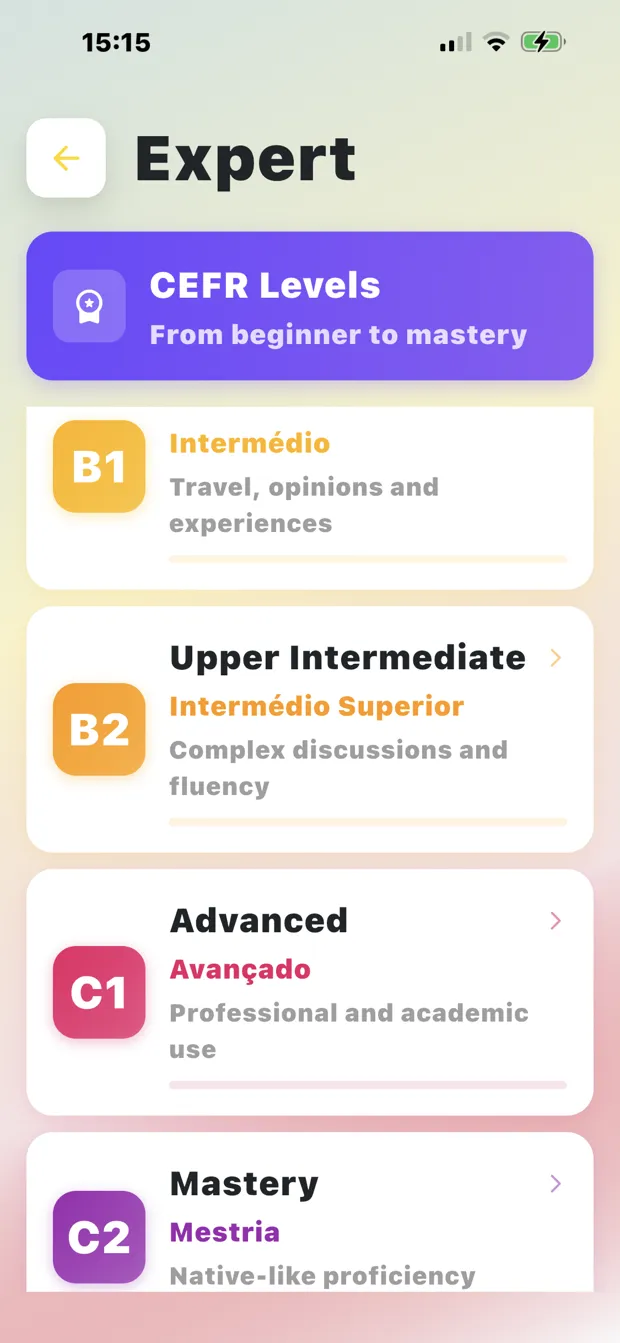
Most big apps teach Brazilian Portuguese, which is why so many learners arrive in Lisbon unable to understand anyone. Portugal Lifestyle Pro is built exclusively for European Portuguese: 500+ CEFR lessons from A1 to C2, native audio from Lisbon and Porto, 20+ games, and the culture that goes with the language.
Download Free on the App Store Google Play Web App
Free download · 500+ lessons · Native Lisbon audio
On the App Store as Learn European Portuguese Pro
What should we build next?
This guide exists because someone asked for it. If there's a topic, lesson type or feature you want in Portugal Lifestyle Pro, tell us — it's five questions and takes about two minutes.
Share your ideas & feedback → No account needed · Email optional · We read every answer