Living in Portugal: The Honest Guide for New Residents
Portugal keeps topping "best country for expats" lists — sunshine, one of the world's lowest crime rates, 800km of coastline and people who are genuinely welcoming. The lists skip the parts that actually fill your first year: the paperwork, the queues, and the gap between the Portugal you visited and the Portugal you live in. Here's the honest version.
Your first month: the paperwork order
There is a correct sequence, and doing it out of order costs weeks. In practice:
- NIF (número de identificação fiscal) — your tax number, from Finanças. Nothing else works without it. Bring your passport and proof of address.
- Bank account — you need the NIF first. Most banks also want proof of address and proof of income.
- Register your lease with Finanças. Your landlord must do this. An unregistered lease is not accepted as proof of address by AIMA, and plenty of people discover this at the appointment itself.
- AIMA appointment for your residence permit.
- NISS (número de identificação da segurança social) — your social security number, needed to work or to access certain benefits.
- SNS registration at your local health centre.
Two survival rules for every one of these: bring originals plus two photocopies of everything you own, and never assume the person at the counter will accept the same documents as the last one did.
Healthcare: SNS and private, side by side
Once you are a legal resident you can register with the SNS (Serviço Nacional de Saúde) at your local centro de saúde. Take your residence permit, NIF, NISS and proof of address. You are assigned a family doctor — though in some areas there is a waiting list for one, which is the single most common complaint about the system.
The care itself is good and very cheap. The trade-off is waiting times for non-urgent specialists, which is why a large share of expats also carry private insurance at roughly €30–100 a month depending on age and cover. The common pattern is SNS for serious things and emergencies, private for speed on everything else.
Pharmacies deserve a special mention. Portuguese pharmacists handle a lot of what would be a doctor's appointment elsewhere, and they are excellent. They mostly operate in Portuguese.
Cost of living: good, with asterisks
Outside Lisbon, Porto and the Algarve hotspots, Portugal is still among Western Europe's most affordable countries. Inside them, housing has risen sharply enough to change the whole calculation — rent is the asterisk on every optimistic budget you will read.
Day-to-day costs stay genuinely low almost everywhere: a prato do dia lunch for €9–15, an espresso around €1, a monthly transport pass around €40. Utilities surprise people in the other direction, especially in winter: Portuguese houses are famously badly insulated, and electricity is not cheap, so a damp January in an older flat can cost more to heat than a northern European one.
The honest summary: your groceries and your social life will be cheaper than you expect, your rent may not be, and your heating bill will annoy you.
Bureaucracy is the national sport
It is slow, it loves paper, and the answer varies by office and by clerk. Treat it as a process to be managed rather than a problem to be solved. Book early, go in person, be polite, and go back.
AIMA appointments are the main bottleneck for new residents. Lisbon and Porto have the longest waits; Braga, Coimbra and Évora move faster. Slots are released unpredictably, so check frequently rather than once a week. Some offices operate same-day atendimento espontâneo queues if you arrive before they open.
This is also where knowing some Portuguese stops being a nice-to-have. Understanding the clerk's question the first time can be the difference between finishing today and waiting another three months — see our Portuguese for expats guide for the vocabulary that actually comes up.
Where to live
- Lisbon — capital energy, the most international, the most expensive, and the hardest rental market.
- Porto — culture and character at somewhat lower prices, with a colder, wetter winter than people expect.
- The Algarve — sun, beaches and the largest foreign community, but strongly seasonal: towns that heave in August can feel shuttered in February.
- Braga, Coimbra, Aveiro — university cities at real-Portugal prices, where English gets you noticeably less far.
- Madeira and the Azores — island life with growing remote-work scenes, and the logistics that come with being on an island.
Our regions guide and best small towns go deeper on the trade-offs.
Practical things nobody warns you about
- Driving licences. EU licences exchange easily. Non-EU holders need to exchange within a set window of becoming resident, and leaving it late can mean sitting the Portuguese test.
- Heating. Most housing has no central heating. Buy a dehumidifier before your first winter, not during it.
- Renting. Landlords commonly ask for several months up front, and a fiador (guarantor) is often requested from people without Portuguese income.
- August. Much of the country, including a lot of small businesses and services, effectively pauses.
- Cash. Multibanco is everywhere and excellent, but plenty of small cafés and rural restaurants remain card-shy.
Common questions
What do I need to do first when I arrive in Portugal?
Get your NIF, the Portuguese tax number, from a Finanças office. Opening a bank account, signing a lease, setting up utilities and applying for residency all depend on having it, so nothing else can start until it exists.
Can I use the Portuguese public health service as a foreign resident?
Yes. Once you hold a residence permit you can register with the SNS at your local health centre, taking your residence permit, NIF, NISS and proof of address. Care is inexpensive and good, though waiting times for non-urgent specialists lead many residents to add private insurance alongside it.
Is Portugal still cheap to live in?
Outside Lisbon, Porto and the Algarve hotspots, yes — food, transport and eating out remain among the most affordable in Western Europe. Housing in the major cities has risen sharply and is the main thing that breaks expat budgets, along with winter electricity bills in poorly insulated homes.
Can I live in Portugal without speaking Portuguese?
In Lisbon, the Algarve and the expat-heavy areas, you can get by in English for a long time. Outside them, and in every dealing with Finanças, AIMA or a health centre, it becomes a real handicap. Most people who learn the language describe it as living in a different country afterwards.
How long does it take to get a residence card after arriving?
Expect several months. Getting an AIMA appointment typically takes one to six months depending on the office, processing afterwards takes a further two to four months, and the card arrives a few weeks after that.
The language factor
You can live in Portugal in English. But every expat who learned Portuguese says the same thing, almost word for word: it is a different country once you speak it. Prices change, bureaucracy softens, neighbours become friends rather than people you nod at. A2 is where the shift happens — enough to handle an appointment, a lease and a conversation — and it is reachable in months, not years. It is also the level Portuguese citizenship requires, so the effort is never wasted.
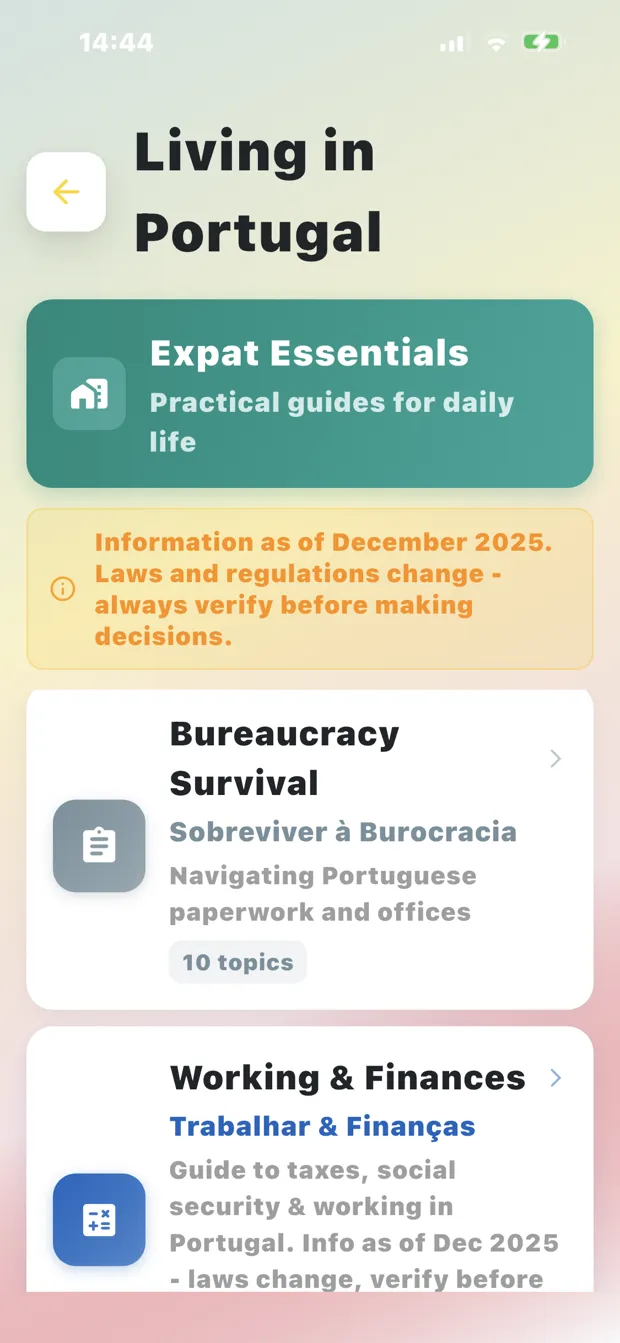
Do it with Portugal Lifestyle Pro
Portugal Lifestyle Pro doubles as a living-in-Portugal toolkit: AIMA guide with appointment vocabulary, healthcare info, city guides for Lisbon, Porto, Algarve and Azores, currency and metric converters — alongside the language course that gets you to that life-changing A2.
Download Free on the App Store Google Play Web App
Free download · 7-day free trial · 500+ lessons · Native Lisbon audio
On the App Store as Learn European Portuguese Pro
What should we build next?
This guide exists because someone asked for it. If there's a topic, lesson type or feature you want in Portugal Lifestyle Pro, tell us — it's five questions and takes about two minutes.
Share your ideas & feedback → No account needed · Email optional · We read every answer