Ordering Food in Portuguese: Restaurant Phrases That Work
Ordering food is the single highest-value thing to learn early in Portuguese. You'll do it every day, the vocabulary repeats endlessly, and getting it right earns you genuine warmth from people who are used to being addressed in English.
Everything below is European Portuguese as spoken in Portugal. Where it matters, we've flagged where Brazilian Portuguese differs — see our full comparison.
Getting seated
| Portuguese | English | Pronunciation |
|---|---|---|
| Boa tarde. Uma mesa para dois, por favor. | Good afternoon. A table for two, please. | boh-ah TARD, oo-ma MEH-za pra doysh |
| Tem mesa para quatro? | Do you have a table for four? | tayng MEH-za pra KWA-troo |
| Temos reserva. | We have a reservation. | TEH-moosh reh-ZEHR-va |
| Podemos sentar-nos lá fora? | Can we sit outside? | poo-DEH-moosh sen-TAR-noosh la FOH-ra |
Greet with bom dia before noon, boa tarde from midday until dark, and boa noite after. Portuguese people greet on entering a room, and skipping it reads as rude.
Ordering
| Portuguese | English |
|---|---|
| A ementa, por favor. | The menu, please. |
| Queria… | I would like… (the polite everyday form) |
| Para mim, o bacalhau à Brás. | For me, the bacalhau à Brás. |
| Qual é o prato do dia? | What's the dish of the day? |
| O que recomenda? | What do you recommend? |
| Uma meia dose, por favor. | A half portion, please. |
| Sem couvert, obrigado. | Without the couvert, thank you. |
| Mais um, por favor. | One more, please. |
Queria is the workhorse here. It literally means "I wanted", and it's softer and more natural than quero ("I want"), which can sound blunt.
Coffee, properly
Get this right and you'll pass for a regular. In Portugal a plain café means an espresso — nothing else.
- Um café, por favor. — an espresso (in Lisbon you'll also hear uma bica)
- Uma meia de leite. — half coffee, half milk, in a cup
- Um galão. — milky coffee in a tall glass
- Um abatanado. — a longer black coffee
- Um pingado. — espresso with a drop of milk
- Um descafeinado. — decaf
In Porto, an espresso is often called a cimbalino. Order a bica there and you'll be marked as a Lisboeta immediately, which is either a mistake or a joke depending on your tone.
Dietary needs
| Portuguese | English |
|---|---|
| Sou vegetariano / vegetariana. | I'm vegetarian (m / f). |
| Sou vegano / vegana. | I'm vegan (m / f). |
| Sou alérgico a… / alérgica a… | I'm allergic to… (m / f) |
| Não como carne nem peixe. | I don't eat meat or fish. |
| Isto leva glúten? | Does this contain gluten? |
| Sem picante, por favor. | Not spicy, please. |
Worth knowing: many Portuguese dishes contain pork or fish stock in ways that aren't obvious, and "vegetarian" is sometimes interpreted loosely outside cities. Naming the specific ingredient is safer than naming the diet.
Paying
- A conta, por favor. — The bill, please. (The single most useful sentence in this guide.)
- Podemos pagar com cartão? — Can we pay by card?
- Podemos pagar separado? — Can we pay separately?
- Está tudo, obrigado. — That's everything, thanks.
- Fique com o troco. — Keep the change.
You'll often be asked "Quer fatura com contribuinte?" — whether you want your tax number (NIF) on the receipt. If you have one, giving it enters you into the tax deduction system. If not, just say não, obrigado.
Menu vocabulary worth knowing
| Portuguese | English | Portuguese | English |
|---|---|---|---|
| entradas | starters | frango | chicken |
| pratos principais | main courses | porco | pork |
| sobremesas | desserts | vaca / bife | beef / steak |
| bebidas | drinks | peixe | fish |
| grelhado | grilled | marisco | shellfish |
| frito | fried | legumes | vegetables |
| assado | roasted | batatas | potatoes |
| cozido | boiled | arroz | rice |
Four mistakes to avoid
- Assuming the couvert is free. The bread and olives are charged. Decline with sem couvert, obrigado if you don't want them.
- Using Brazilian vocabulary. Ask for suco instead of sumo, or banheiro instead of casa de banho, and you'll be understood — but marked instantly as having learned the wrong variant.
- Saying obrigado with the wrong ending. It agrees with you, the speaker: men say obrigado, women say obrigada, regardless of who they're thanking.
- Not greeting. Walking in and launching straight into an order skips a step that matters socially.
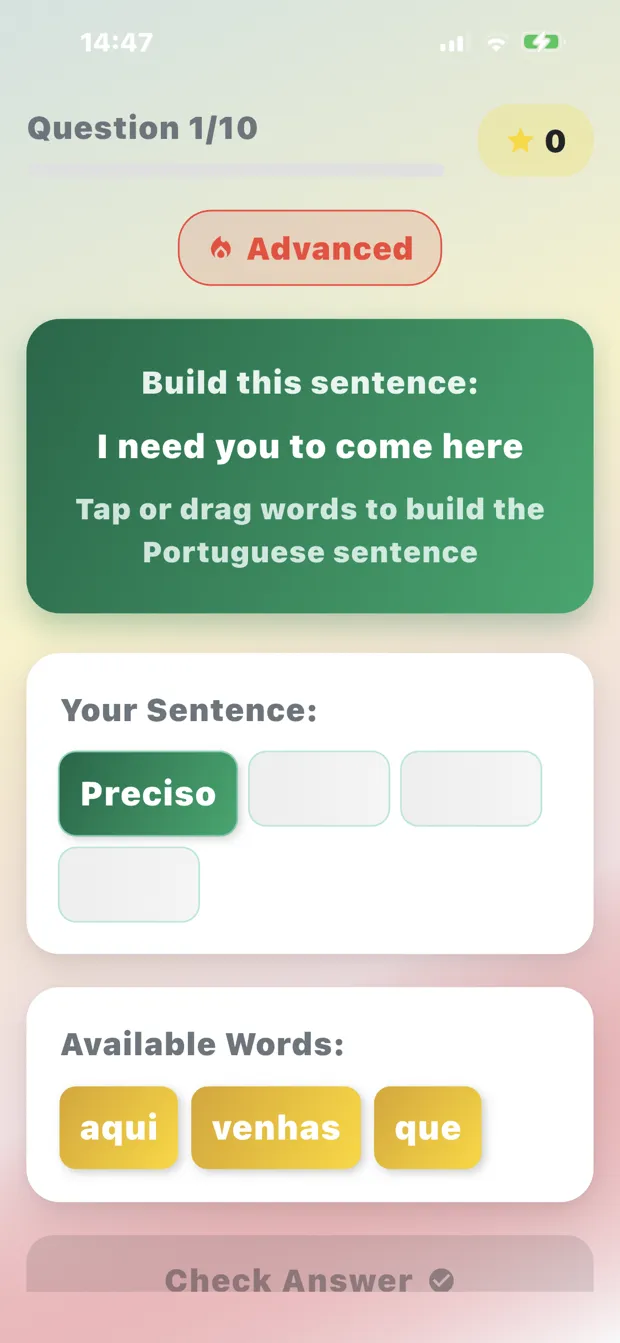
Practise these patterns free in our Sentence Builder game, which drills exactly this kind of everyday European Portuguese sentence.
Frequently asked questions
How do you order food in Portuguese?
Greet first with bom dia or boa tarde, then use Queria followed by the dish and por favor. For example: Queria o bacalhau à Brás, por favor. Queria is softer and more polite than Quero, and is what Portuguese people actually use.
How do you ask for the bill in Portugal?
Say A conta, por favor. It's the standard phrase everywhere in Portugal. You can also catch the server's eye and make a small writing gesture, which is widely understood.
Do I need to tip in Portuguese restaurants?
Tipping is modest and not obligatory. Rounding up the bill or leaving 5 to 10 percent for good service is normal. Service charges are not usually added automatically.
What is a couvert in a Portuguese restaurant?
The couvert is the bread, olives, cheese or pâté brought to your table at the start of a meal without being ordered. It is charged for, usually a few euros. You can decline it by saying sem couvert, obrigado and it will not be billed.
How do you order coffee in Portugal?
Say um café, por favor for an espresso, which is the default. For milky coffee ask for uma meia de leite in a cup or um galão in a tall glass. In Lisbon an espresso is also called uma bica, and in Porto a cimbalino.
Learn the language that goes with it
Restaurant Portuguese is where most learners get their first real win. Portugal Lifestyle Pro has café, restaurant and shopping scenarios with native Lisbon audio and an AI conversation partner, so you can rehearse the whole exchange before you walk in.
Download Free on the App Store Google Play Web App
Free download · 7-day free trial · 500+ lessons · Native Lisbon audio
On the App Store as Learn European Portuguese Pro
What should we build next?
This guide exists because someone asked for it. If there's a topic, lesson type or feature you want in Portugal Lifestyle Pro, tell us — it's five questions and takes about two minutes.
Share your ideas & feedback → No account needed · Email optional · We read every answer